Heat Damaged Hair: Signs, Causes & Prevention Tips
Heat Damage
What's Really Happening to Your Hair?
Why heat styling affects your hair, how to recognize damage and how to protect your hair without giving up the styles you love.
By Kerri Jarrett | Certified Trichologist, Red Seal Hairstylist & Educator
Let me start by saying something that might surprise you.
I'm not against heat styling.
I've spent years behind the chair, and I know what a good blowout, a flat iron or a curling wand can do for someone's confidence. Sometimes you just want your hair to cooperate, and there's absolutely nothing wrong with that.
But here's what I want you to understand.
There's a difference between using heat to style your hair and repeatedly exposing your hair to more heat than it can tolerate.
And sometimes, by the time we notice the damage, it's been building for quite a while.
So let's talk about what's actually happening to your hair when you turn up the temperature.
What Is Thermal Damage?
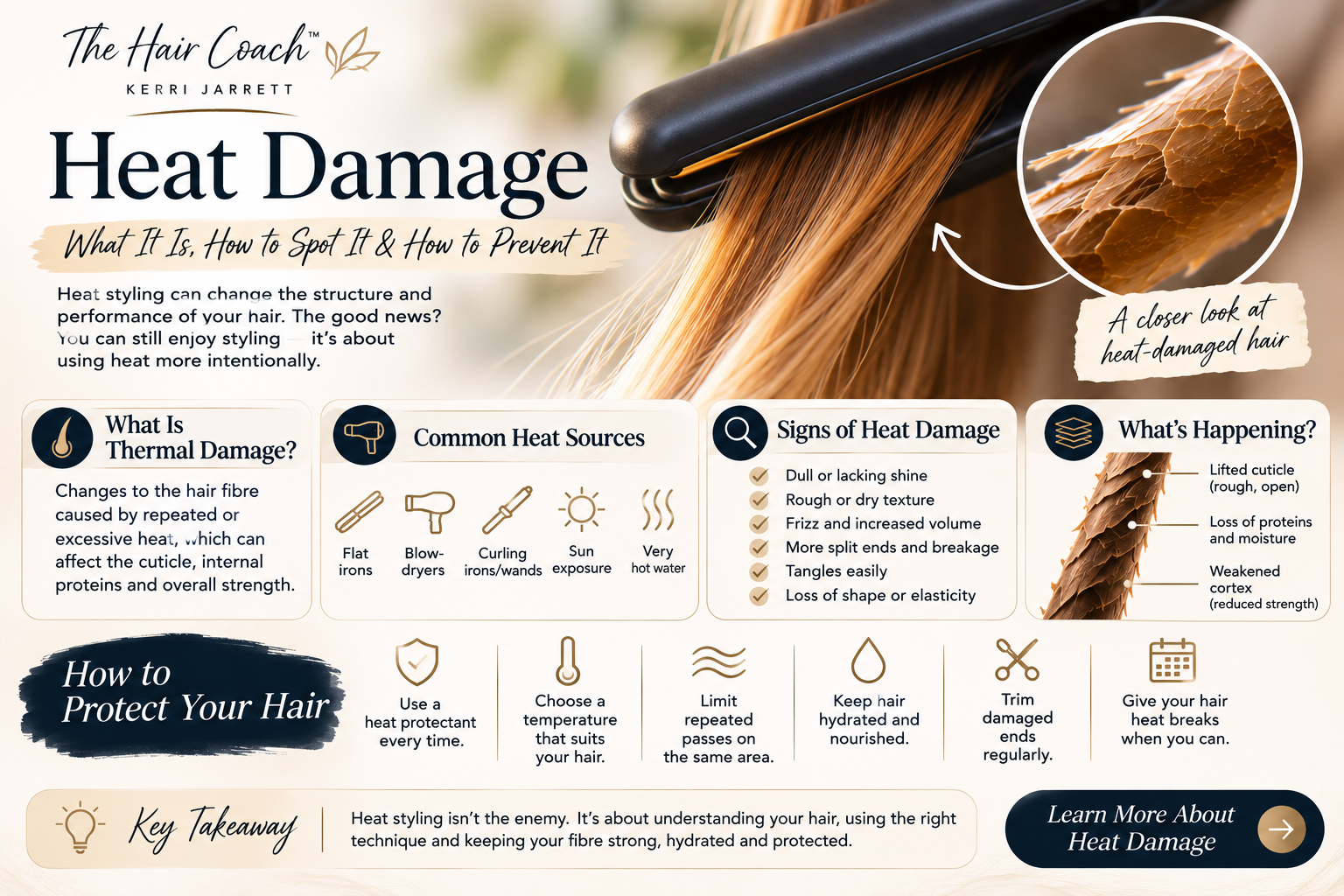
Thermal damage, more commonly called heat damage, happens when exposure to high temperatures changes the physical or chemical structure of the hair fibre.
Your hair is made primarily of keratin proteins, along with water, lipids and other components that influence its strength, flexibility and appearance.
The outer layer, called the cuticle, helps protect the inner cortex.
When hair is exposed to excessive heat, several things can happen.
The cuticle can become damaged. The hair can lose water rapidly. At sufficiently high temperatures, proteins and other structural components can be altered.
Over time, these changes can affect how the hair looks, feels and behaves.
You might notice more roughness, tangling, breakage or a change in your natural texture.
And here's something worth remembering:
Hair doesn't have to look burnt to be heat damaged.
Sometimes the early signs are much more subtle.
What Actually Happens When You Apply Heat?
When you use a blow-dryer or flat iron, you're changing the temporary bonds and water interactions that help give hair its shape.
That's why you can blow-dry curly hair straight or use a curling iron to create waves.
Under appropriate conditions, these styling changes are temporary.
But excessive temperatures, repeated exposure and poor technique can create more lasting changes.
The Cuticle Can Become Compromised
Think of the cuticle as the protective outer surface of the hair.
When it's in relatively good condition, it helps reduce friction and contributes to the hair's appearance and manageability.
Repeated heat exposure can contribute to surface wear and cuticle damage.
The result?
Hair that feels rougher, tangles more easily or doesn't reflect light the way it once did.
The Cortex Can Be Affected
The cortex provides much of the hair's mechanical strength and elasticity.
With sufficiently intense heat exposure, proteins and other internal components can undergo changes that weaken the fibre.
This is when you may start noticing increased brittleness, reduced resilience or hair that breaks more easily during everyday handling.
Your Natural Texture May Change
Have you ever noticed a section of curly hair that suddenly doesn't curl the way it used to?
Or hair that feels unusually stiff and doesn't move naturally?
Significant heat damage can alter the hair's structure enough to affect its behaviour.
For someone with naturally curly or wavy hair, this may appear as sections that remain straighter or lose their usual curl pattern.
And unfortunately, when those changes are caused by permanent structural damage, a conditioning treatment may improve the feel of the hair without restoring its original curl pattern.
Is Your Hair Heat Damaged? Here's What to Look For
Some common signs include:
Hair that feels rough, dry or unusually brittle.
Increased tangling, especially through the mid-lengths and ends.
Dullness or reduced shine.
More split ends or short broken strands.
Changes in elasticity or flexibility.
Hair that doesn't respond to styling the way it used to.
Sections of curly or wavy hair that have lost their natural pattern.
But I want to make an important distinction.
Frizz doesn't automatically mean heat damage. Neither does dry hair.
Hair can be frizzy because of its natural texture, humidity, styling techniques or a combination of factors.
And dryness can have several explanations.
That's why looking at one symptom and immediately reaching for a repair product isn't always the best approach.
We need to look at the whole picture.
Why Does Some Hair Experience More Heat Damage Than Others?
This is where your hair's individual characteristics really matter.
Two people can use the same styling tool at the same temperature and have very different experiences.
Why?
Because the hair may not be in the same condition to begin with.
Previous Chemical Processing
Bleached, coloured or chemically treated hair may already have structural changes that affect its ability to tolerate additional stress.
Adding frequent high-temperature styling can increase the risk of further damage.
Hair Diameter and Existing Condition
Fine hair and hair with significant existing damage may require a more conservative approach to styling.
But hair diameter alone doesn't determine how much heat is safe.
The condition of the fibre, the tool, the amount of moisture present and the styling technique all matter.
Frequency of Styling
Using a flat iron occasionally isn't the same as using it every day.
Repeated exposure can contribute to cumulative damage, particularly when the same sections receive multiple passes.
Styling Technique
This one is huge.
You can have an expensive flat iron and still damage your hair if you're using excessive temperatures, moving too slowly or repeatedly going over the same section.
The tool matters. But how you use it matters just as much.
Let's Talk About Heat Protectants
I often hear people say, "But I use a heat protectant!"
That's great. Heat protection can be an important part of your styling routine.
But it doesn't mean your hair is protected from every possible temperature or styling habit.
Heat protectants work through different formulations and ingredients. Some help reduce friction, improve heat distribution or limit certain forms of damage during styling.
Their effectiveness depends on the product, how it's applied and the conditions in which it's used.
So no, applying a heat protectant doesn't give us permission to turn every flat iron up to its highest setting.
And using more product isn't necessarily better either.
The goal is appropriate protection combined with sensible styling.
What Temperature Should You Use?
Here's where I don't believe in giving everyone one magic number.
The right temperature depends on your hair's characteristics, its current condition and the tool you're using.
Fine, fragile, bleached or previously damaged hair generally deserves a more cautious approach.
Coarser or more resistant hair may require different techniques, but that doesn't automatically mean it needs the highest heat setting.
My advice?
Start lower than you think you need and increase only when necessary.
Use controlled sections, avoid unnecessary passes and pay attention to how your hair responds.
If you're constantly turning up the heat because your style isn't holding, it may be time to look at your preparation, products or technique rather than simply increasing the temperature.
And one particularly important point: don't use a conventional flat iron or curling iron on wet hair unless the tool is specifically designed and validated for that purpose.
Rapid heating of water within the fibre can cause significant damage.
Can Heat-Damaged Hair Be Repaired?
This is where we need to separate cosmetic improvement from structural repair.
There are some excellent conditioning, strengthening and bond-building products available.
Depending on the formulation, they may improve the feel, appearance, lubrication or certain mechanical properties of damaged hair.
That can make a meaningful difference.
But hair outside the scalp is not living tissue.
Once the fibre has experienced permanent structural damage, it cannot biologically regenerate itself.
So when someone asks me whether we can repair heat damage, my answer is usually:
We can often improve how the hair looks, feels and performs. But we can't promise to reverse everything that's happened inside the fibre.
If the ends are severely damaged, trimming may be necessary.
If the hair is breaking, we need to identify what's contributing to it.
And if the natural curl pattern has been permanently altered, the most realistic approach may involve protecting the remaining hair while allowing new growth to come in.
This is also why I encourage people to understand the difference between fragile hair, hair breakage and split ends. They're connected, but they aren't exactly the same concern.
How to Protect Your Hair Without Giving Up Heat Styling
You don't necessarily need to throw away your blow-dryer or retire your curling iron.
You may just need to change how you're using them.
1. Prepare Your Hair Properly
Start with appropriate cleansing and conditioning.
Choose styling products that support your hair's condition and the result you're trying to achieve.
For blow-drying, gently remove excess water before styling rather than starting with dripping-wet hair.
2. Use a Suitable Heat Protectant
Choose a product intended for your styling method and follow the manufacturer's directions.
Some products are designed for blow-drying, while others are formulated for higher-temperature tools.
They're not necessarily interchangeable.
3. Adjust Your Temperature
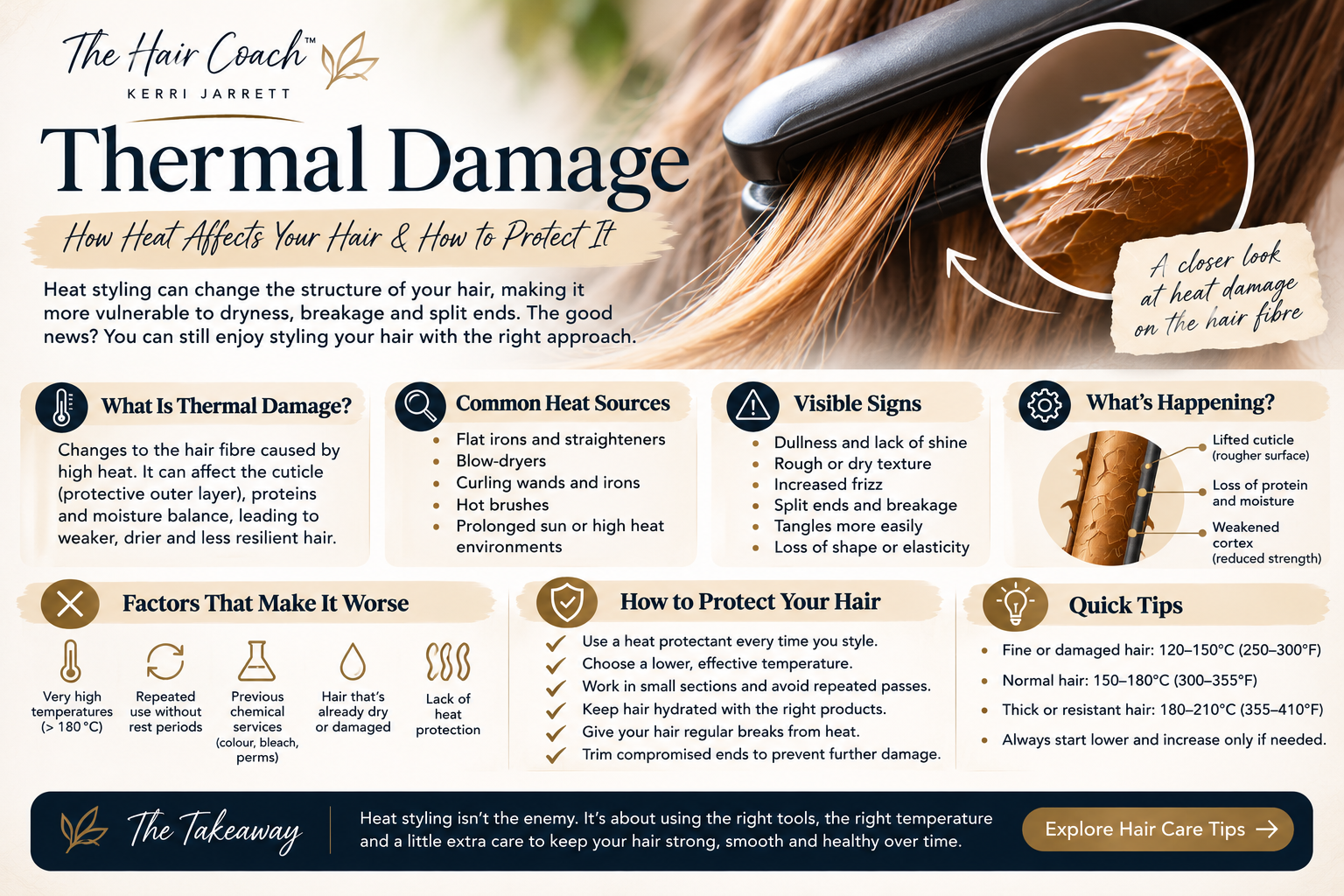
Use the lowest practical temperature that gives you the result you're looking for.
Remember that more heat doesn't always mean better styling.
4. Avoid Repeated Passes
Work in manageable sections and use appropriate technique.
If you're going over the same section five or six times, something in the process probably needs adjusting.
5. Be Mindful of Your Hair's Chemical History
If your hair has been recently lightened or is already showing signs of damage, you may need to reduce heat exposure or modify your styling routine.
6. Give Your Hair a Break When It Needs One
Try alternating heat styling with lower-heat or heat-free techniques when practical.
A little flexibility in your routine can reduce cumulative exposure.
7. Don't Ignore Your Ends
Heat damage often becomes particularly noticeable through older, more weathered lengths.
If you're noticing repeated splitting or breakage, a maintenance cut may help remove compromised ends and protect the remaining length.
This is also where my SOS Cut can be worth exploring.
It's a length-conscious approach to addressing damaged ends rather than automatically taking off more hair than necessary.
What If Your Hair Already Has Significant Heat Damage?
Sometimes a few changes to your styling routine are enough to reduce further damage.
Other times, the hair is already so compromised that continuing with the same techniques isn't realistic.
If your hair is snapping, feels unusually rough, has lost much of its elasticity or is no longer responding to treatments, it may be time for a closer assessment.
We can look at your hair's condition, chemical history, styling practices and what you realistically want to achieve.
Because sometimes the answer is a different product.
Sometimes it's a different styling technique.
And sometimes it's a haircut and a plan to protect your new growth.
There's no shame in any of those options.
A Little Understanding Goes a Long Way
One thing I've learned throughout my career is that people don't necessarily need to stop doing everything they enjoy with their hair.
They need to understand what their hair can tolerate.
As a Red Seal Hairstylist and Certified Trichologist, I approach heat damage from both a cosmetic and structural perspective.
I want you to enjoy your hair, learn how to style it and feel confident doing it.
But I also want you to understand the choices you're making along the way.
If you're struggling with styling, product selection or repeated damage, personalized hair coaching can help you build a routine that makes sense for your hair and lifestyle.
If you're experiencing severe breakage, unexplained changes in hair quality, increased shedding or scalp concerns, a Comprehensive Trichology Assessment, available in person or virtually, may be a more appropriate starting point.
And if you're unsure which direction to take, you're always welcome to book a complimentary 15-minute discovery call.
You don't have to give up styling your hair. You just need to understand how to work with it.
Kerri Jarrett
Certified Trichologist | Red Seal Hairstylist | Educator
Explore Hair Fibre Education | Learn About the SOS Cut | Book a Free Discovery Call
Fragile Hair: When discussing how heat affects fibre strength and resilience.
Hair Breakage: When explaining how repeated heat exposure contributes to snapping and uneven lengths.
Split Ends: In the section about damaged ends and your SOS Cut.
Hair Fibre 101: When explaining the cuticle, cortex and structural changes.
Hair Porosity: When discussing how fibre condition affects water absorption and hair behaviour, once that article is available.


Let’s Talk Hair.
Hair loss. Scalp health. Hair growth. Hair fibre. Hair care. Get evidence-informed education, practical insights and new resources delivered to your inbox—designed to help you better understand what your hair and scalp may be telling you and make more informed decisions about what comes next. Because better questions lead to better answers.


