Split Ends: Causes, Prevention & Why Trimming Matters
Split Ends
Why Cutting Your Hair Might Actually Help You Keep Your Length
Split ends aren't just about appearance. Discover why hair begins to fray, why treatments can't permanently repair a split fibre and how strategic trimming can help protect the length you've worked to grow.
By Kerri Jarrett | Certified Trichologist, Red Seal Hairstylist & Educator
I can't tell you how many times I've had someone sit in my chair and tell me they're growing their hair, so they don't want anything cut off.
And I get it. You've spent months, maybe even years, trying to get your hair to a certain length. The last thing you want is someone coming along with scissors.
But here's the thing. Sometimes avoiding a haircut is actually working against what you're trying to achieve.
Especially when split ends are involved.
What Exactly Is a Split End?
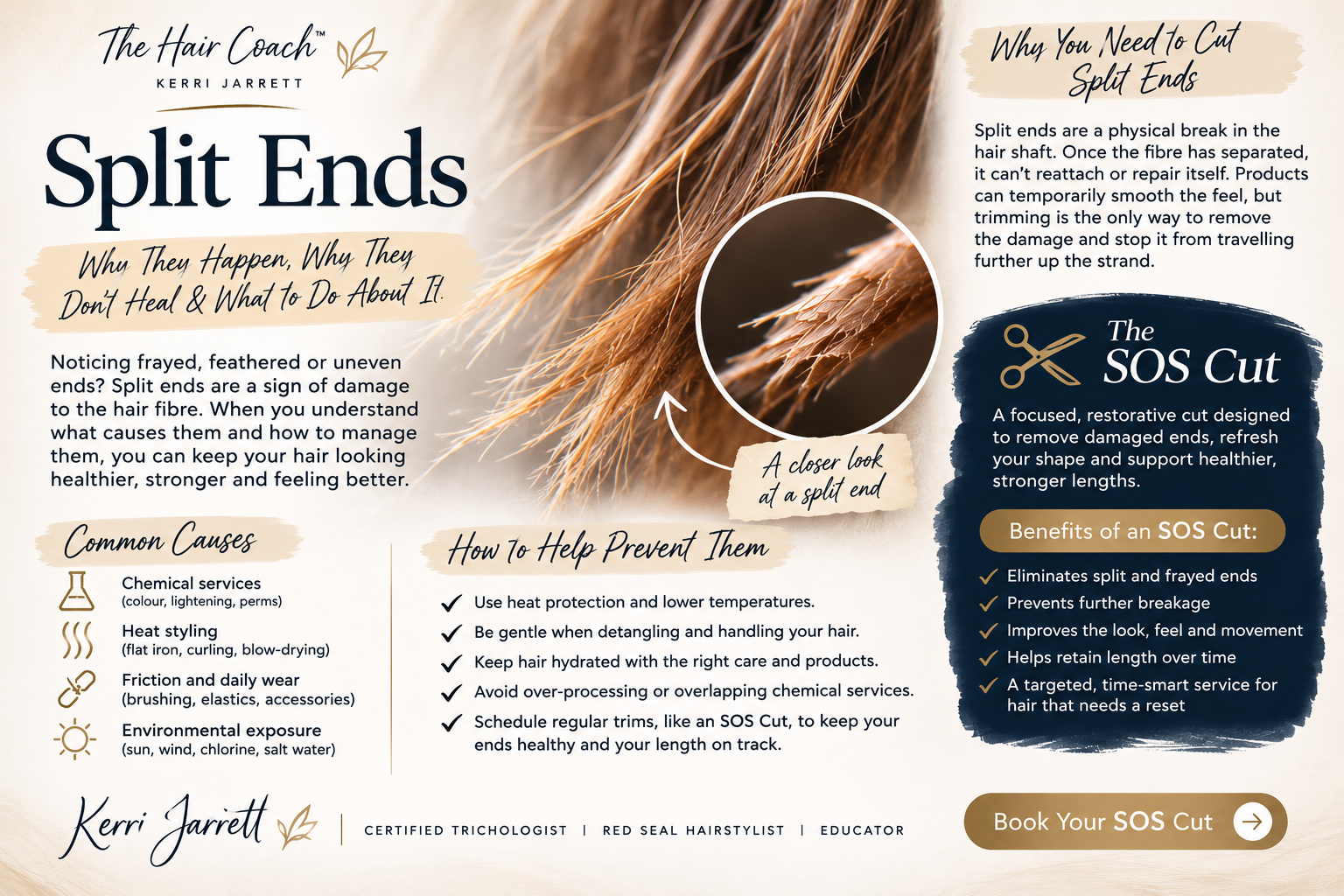
A split end happens when the end of your hair shaft starts to separate. The protective outer layer, called the cuticle, becomes worn or damaged, leaving the internal structure more vulnerable.
Sometimes you'll see a little Y-shaped split. Other times, the ends look feathered, frayed or almost like a tiny paintbrush.
And they don't always happen just at the very tips. Hair can develop splits and fractures farther along the shaft, too.
The important thing to understand is that once the hair has physically split, it can't heal itself.
Hair is made of keratinized cells. The part we see and style isn't living tissue, so it doesn't have the ability to regenerate the way our skin does.
That brings me to something I think we need to talk about more often.
Can You Actually Repair Split Ends?
You've probably seen products claiming to repair split ends.
And to be fair, some of these products can do a pretty good job of making damaged ends look and feel better.
Conditioning ingredients can smooth the surface, reduce friction and temporarily hold separated fibres together.
But that doesn't mean the hair has been permanently repaired.
There's a difference between making damaged hair look healthier and actually removing the damage.
I think that's an important distinction, especially when we're spending money on products expecting them to do something they physically cannot do.
I'm not against treatments. Far from it. I use and recommend them when they serve a purpose.
But a treatment and a haircut do two different jobs.
Why Do Split Ends Happen in the First Place?
Think about how much your hair goes through.
We wash it, brush it, colour it, blow-dry it, straighten it, curl it, tie it up and sometimes sleep on it while it's still tangled.
And then there's the environment. Sun, wind, dry air, chlorine and everything else our hair comes into contact with.
Your ends have been around the longest, which means they've experienced more of that wear and tear than the hair closer to your scalp.
Chemical processing and excessive heat can weaken the fibre, while repeated brushing, friction and tension can gradually wear down the cuticle.
Often, it's not one particular thing causing the problem.
It's the combination of everything.
This is also why someone with naturally fine hair may need a different maintenance approach than someone with coarse, minimally processed hair.
Different hair. Different histories. Different needs.
So Why Do You Actually Need to Cut Split Ends?
Here's where I think people sometimes misunderstand the purpose of a haircut.
It's not just about keeping a particular shape or style.
When the ends of your hair are split, those damaged sections can catch on neighbouring strands, create tangles and become more vulnerable to breaking.
Some splits can also extend farther along the hair shaft.
Not every split end will travel all the way up your hair, but leaving severely compromised ends in place can make it harder to maintain the condition of your lengths.
By cutting above the damaged section, we're removing the split rather than trying to disguise it.
And when the ends are in better condition, they often detangle more easily, look fuller and are less likely to snag during everyday styling.
Cutting your hair doesn't make it grow faster. But it can help you keep more of the hair you're growing.
That's what length retention is all about.
But I Don't Want to Lose My Length!
I hear you.
And this is exactly why I believe haircuts should be approached with intention.
Not everyone needs two inches removed every six weeks. In fact, I don't believe in putting everyone on the same haircut schedule.
Some people can go months between trims without significant damage. Others, particularly those with heavily processed or frequently heat-styled hair, may need more regular attention.
What matters is the condition of the hair, not simply how many weeks have passed.
And sometimes, you don't need a completely new haircut.
You just need to deal with the damaged parts.
This Is Where My SOS Cut Comes In
I offer an SOS Cut for people who want to address damaged ends without automatically sacrificing more length than necessary.
The idea is simple.
We look at the condition of your hair, where the damage is occurring and what needs attention.
The goal is to remove compromised ends where possible, improve manageability and preserve as much healthy length as we reasonably can.
For someone trying to grow their hair longer, this can be an important part of their maintenance plan.
It can help reduce snagging and tangling, remove existing splits and leave the ends looking fuller and more intentional.
But I also want to be clear about something.
If the damage extends several inches up the hair shaft, a small trim isn't going to magically correct all of it.
Sometimes we need to remove more. Sometimes we can work toward healthier ends gradually, over several appointments.
I'd rather have that conversation with you than promise that a treatment or tiny trim will fix something it can't.
The goal isn't to cut as little as possible at any cost. It's to keep as much healthy hair as possible.
How Can You Help Prevent Split Ends?
There are a few things I encourage people to pay attention to.
How are you brushing your hair? If you're pulling through tangles or repeatedly brushing against resistance, you may be contributing to unnecessary mechanical damage.
How much heat are you using? A heat protectant is helpful, but temperature, technique and frequency still matter.
Are you conditioning appropriately? Conditioning helps reduce friction and makes hair easier to manage. Your hair's characteristics and condition should guide the products you choose.
What is your chemical history? Repeated lightening or overlapping chemical services can leave the ends more vulnerable.
Are you waiting too long between trims? If your ends are already fraying, continuing to avoid cutting them may not be helping your length goals.
And one more thing.
You don't necessarily need a shelf full of expensive products.
You need products that make sense for your hair and an understanding of what they're actually supposed to do.
What If Your Ends Keep Splitting?
If you're regularly trimming your hair, taking care of it and still noticing significant splitting or breakage, there may be something in your routine or chemical history worth looking at more closely.
Sometimes it's a relatively simple adjustment.
Other times, we need to consider the condition of the fibre itself, how it responds to tension and whether there are other changes happening with your hair.
If you're also noticing unusual shedding, changes in density or scalp concerns, that's a different conversation and may warrant a more comprehensive assessment.
This is one of the reasons I love bringing cosmetology and trichology together.
It's not just about what your hair looks like today. It's about understanding what's influencing its condition and what we can realistically do to support it.
Let's Talk About Your Hair Goals
If you're trying to grow your hair, struggling with split ends or simply unsure whether you need a haircut or a different care routine, I'm happy to help you figure out where to start.
My SOS Cut may be a good option if your main concern is damaged ends and maintaining length.
If you need help understanding your products, styling habits or overall hair care routine, we can work through that with personalized hair coaching.
And if you're experiencing more significant or unexplained changes, I also offer comprehensive trichology assessments, both in person and virtually, to help explore what's happening and whether additional professional evaluation is needed.
You don't need to know which service is right for you before reaching out. That's what the complimentary 15-minute discovery call is for.
Because sometimes the best thing you can do for your hair isn't to buy something new.
Sometimes it's understanding what needs to go, what needs protecting and what needs to change.
Kerri Jarrett
Book an SOS Cut | Explore Hair Coaching | Book a Free Discovery Call


Let’s Talk Hair.
Hair loss. Scalp health. Hair growth. Hair fibre. Hair care. Get evidence-informed education, practical insights and new resources delivered to your inbox—designed to help you better understand what your hair and scalp may be telling you and make more informed decisions about what comes next. Because better questions lead to better answers.


