Hair Breakage: Causes, Prevention & Hair Care Tips
Hair Breakage: Why Your Hair Keeps Breaking and What You Can Do About It
By Kerri Jarrett | Certified Trichologist, Red Seal Hairstylist & Educator
Growing your hair but never seem to gain any length?
Maybe you've noticed little pieces of hair on your bathroom counter, shorter strands sticking out throughout your hairstyle, or ends that seem to get thinner no matter how long you leave them between haircuts.
One of the first things I like to establish is whether we're dealing with hair that's falling out or hair that's breaking off.
Because those are two very different conversations.
And if your hair is breaking, the solution isn't necessarily a hair growth product.
Sometimes, we need to look at what happens to your hair after it grows.
What Is Hair Breakage?
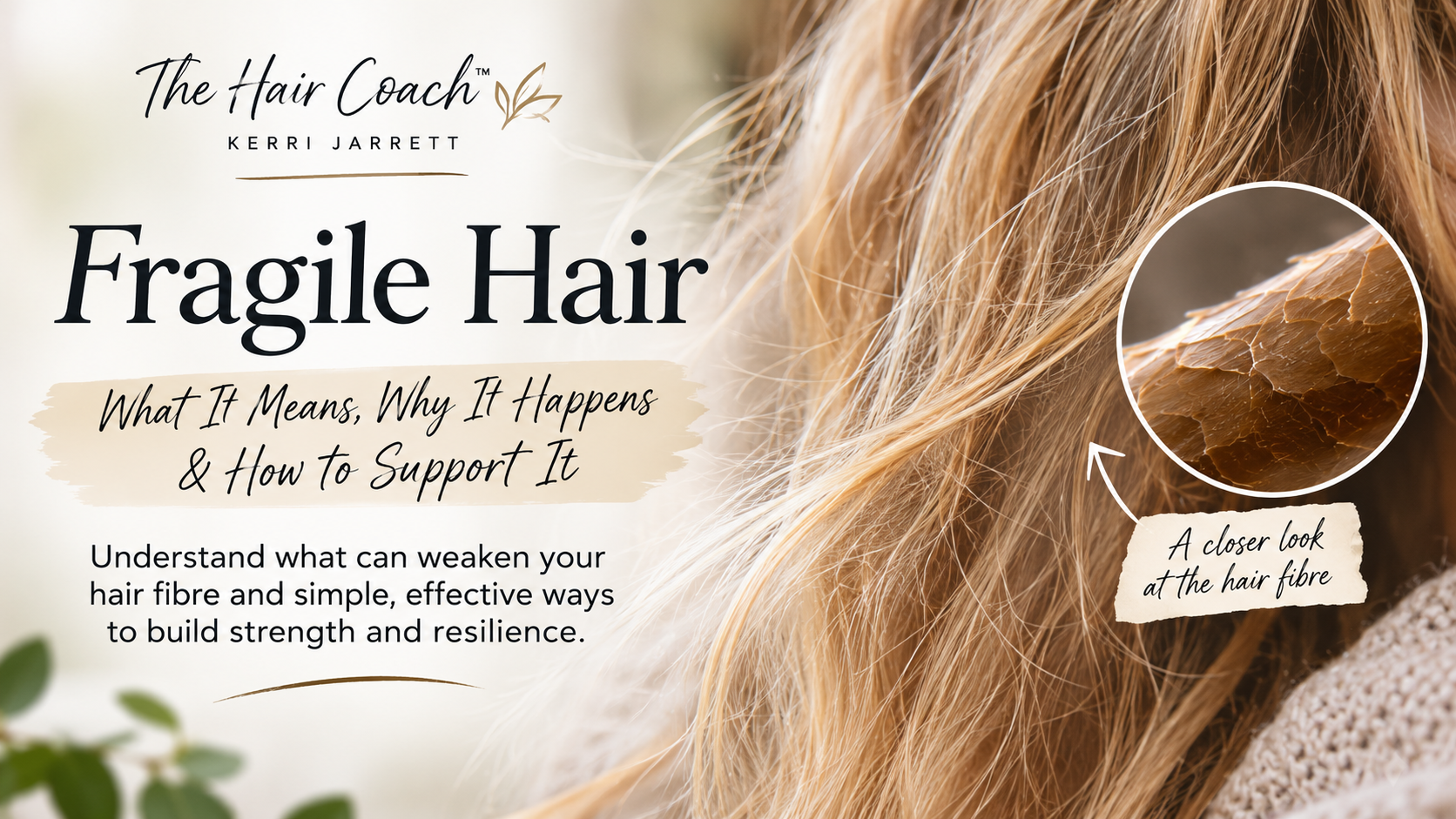
Hair breakage happens when the hair shaft fractures somewhere along its length.
Unlike natural shedding, where a hair is released from the follicle, breakage happens to the fibre itself.
A strand might snap near the ends, halfway down its length or closer to the scalp.
The result can be shorter, uneven strands, reduced fullness through the ends and difficulty retaining length.
Here's something I often remind people:
Your hair can be growing perfectly well at the scalp while you're losing length through breakage.
That's why understanding the difference between hair growth and length retention matters.
Hair Breakage vs. Hair Loss: How Can You Tell?
These two concerns are often confused, especially when someone notices more hair in their brush or shower.
With hair breakage, you may notice shorter pieces, uneven lengths or strands with frayed ends. The hair has physically snapped.
With hair shedding, you'll often see full-length strands that have been released from the follicle as part of the hair cycle. Some may have a small, pale club-shaped end.
And with hair thinning, there may be a reduction in the number of growing hairs, changes in hair diameter or both.
Of course, breakage and hair loss can happen at the same time.
A quick look at a few strands can offer clues, but it doesn't always tell us the whole story.
If you're noticing a significant change in overall density, widening areas of scalp visibility or unusual shedding, it's worth looking beyond the hair fibre.
Why Does Hair Break?
This is where things get interesting.
Hair breakage is rarely about one bad hair day. More often, it's the result of damage and stress accumulating over time.
1. Chemical Processing
Colouring, bleaching, perming and chemical straightening all involve changes to the hair's chemistry.
When appropriately selected and performed, these services can be part of a manageable hair care routine.
But repeated processing, overlapping lightener or treating already compromised hair can weaken the fibre.
Lightening is a particularly important example because the oxidative process can affect the hair's proteins and protective structures.
The result may be hair that tangles more easily, feels rough, stretches abnormally or breaks under ordinary styling tension.
A product may make overprocessed hair feel smoother, but that doesn't necessarily mean its original structural strength has returned.
This is why assessing the condition of the hair before another chemical service is so important.
2. Excessive Heat
Flat irons, curling tools and blow-dryers can all contribute to hair damage when used at unsuitable temperatures or too frequently.
And there's another factor people often overlook: repeated passes.
Going over the same section again and again increases heat exposure, particularly when the hair is already dry, bleached or damaged.
Over time, excessive heat can alter the fibre's physical properties and increase its vulnerability to fracture.
Heat protectants can help reduce certain types of damage, but they don't provide unlimited protection.
Sometimes the best change is simply lowering the temperature, reducing the number of passes or styling less frequently.
3. Friction and Everyday Handling
Not all damage comes from a salon service or a hot tool.
Think about everything your hair comes into contact with throughout the day.
Brushes, combs, elastics, clothing, pillowcases, towels and even your own hands.
Repeated friction can wear down the cuticle and increase tangling. When you combine that with pulling or aggressive detangling, breakage becomes more likely.
Tight ponytails, braids and extensions can also place repeated tension on the hair.
And if that tension affects the follicles over time, we're no longer talking about fibre damage alone. We may also need to consider traction-related hair loss.
4. Environmental Exposure
Sun exposure, wind, saltwater, chlorine and environmental conditions can all influence the hair's condition.
For example, repeated sun exposure can contribute to changes in hair proteins and colour, while swimming and environmental wear may increase roughness or tangling.
These influences don't necessarily cause significant breakage on their own, but they can add to existing damage.
5. The Condition of Your Hair Before Styling
Two people can use the same flat iron, brush or chemical service and experience very different results.
Why?
Because their hair may not have started in the same condition.
Hair diameter, previous chemical processing, existing cuticle wear, elasticity and individual fibre characteristics all affect how hair responds.
What your hair can tolerate today may not be what it could tolerate six months ago.
That's why I don't believe in treating every head of hair with the same routine.
What Does Hair Breakage Look Like?
Some common signs include:
Short, uneven strands throughout the hair.
Frayed, split or irregular ends.
Hair that snaps during brushing or detangling.
Increased tangling and roughness.
Ends that look thinner or less full than the roots.
Hair that appears to stop gaining length despite continued growth.
Breakage may be concentrated around the hairline, at the nape, through the crown or toward the ends.
And that pattern can give us useful information.
For example, breakage near an area repeatedly exposed to tight styling may suggest a different influence than damage concentrated through previously lightened ends.
Where the hair breaks can be just as informative as the fact that it's breaking.
Can Broken Hair Be Repaired?
Here's where I like to separate what a product can do from what marketing sometimes suggests it can do.
Once a hair strand has snapped, it cannot be reattached through a shampoo, conditioner or treatment.
Similarly, severely damaged sections of the fibre cannot biologically heal themselves.
However, that doesn't mean hair treatments are pointless.
Conditioners, leave-in products and certain bond-building or strengthening technologies can improve manageability, reduce friction and improve some properties of damaged hair.
These improvements can help reduce additional breakage.
But there's a difference between improving the condition and performance of existing hair and reversing every bit of structural damage.
Sometimes a treatment is appropriate.
Sometimes a change in styling habits will make the biggest difference.
And sometimes, removing severely damaged ends is the most practical choice.
The goal is to protect the hair you have while giving new growth a better chance of reaching the lengths you want.
How to Reduce Hair Breakage
You don't necessarily need to replace everything in your bathroom cabinet.
Start by looking at how you care for your hair every day.
Be More Intentional With Detangling
Use a suitable brush or wide-tooth comb, work through tangles gradually and avoid pulling against resistance.
Conditioning products can help provide slip and reduce friction.
Wet hair can be particularly vulnerable to certain types of mechanical stress, so handling it gently matters.
Review Your Heat Styling Habits
Use a heat protectant appropriate for your styling method, keep temperatures as low as practical and avoid unnecessary repeated passes.
If your hair is already compromised, consider taking a break from high-heat styling while you work on reducing further damage.
Give Chemical Processing Some Thought
If your hair is breaking after bleaching or other chemical services, continuing with the same approach may make the problem worse.
A professional assessment of the fibre's condition can help determine whether further processing is appropriate.
Choose Products for a Purpose
A shampoo cleanses. A conditioner helps improve lubrication and manageability. A leave-in product may offer additional protection. A targeted treatment may address particular concerns.
Understanding these roles makes it easier to choose products that actually serve your hair.
More products don't automatically mean better results.
Reduce Unnecessary Friction and Tension
Consider looser hairstyles, gentler elastics, careful towel drying and reducing repeated pulling on the same sections.
If your hair tangles heavily overnight, a loose protective hairstyle or smooth pillowcase may help reduce friction.
Don't Ignore Damaged Ends
Regular trimming can help remove split and heavily compromised sections before they continue to tangle and break.
There isn't one haircut schedule that suits everyone. The right timing depends on your hair's condition, styling habits and goals.
What If Your Hair Keeps Breaking Despite Changing Your Routine?
This is when I encourage people to stop guessing.
If you've adjusted your products and styling habits but you're still experiencing significant breakage, it's worth taking a closer look.
We may need to explore your chemical history, the pattern of damage, your hair's physical characteristics and whether something else is contributing to the changes you're noticing.
If the concern involves unusual shedding, changes in density, scalp symptoms or sudden changes in newly growing hair, further assessment may be appropriate.
Not every hair concern can be solved with a conditioning mask.
And that's okay. The important part is knowing what you're dealing with.
Understanding Your Hair Is the First Step
One of the things I enjoy most about working with hair is helping people connect the dots.
Sometimes a few changes to your routine make a noticeable difference.
Other times, we discover that what initially looked like a styling problem deserves a more thorough investigation.
As a Certified Trichologist and Red Seal Hairstylist, I bring together practical cosmetology experience, hair fibre knowledge and evidence-informed education.
If you're struggling with breakage, unsure which products are appropriate or trying to grow your hair longer without losing your ends, personalized hair coaching can help you build a routine that makes sense for your hair and lifestyle.
If you're experiencing persistent or unexplained breakage, significant shedding, changes in density or scalp concerns, we can explore whether a comprehensive trichology assessment, available in person or virtually, is a more appropriate starting point. Medical evaluation may also be recommended when indicated.
You don't need to commit to a complicated program just to ask a question.
A complimentary 15-minute discovery call is a simple place to start.
Understand the follicle. Protect the fibre. Support the person.
Kerri Jarrett
Explore Hair Fibre Education | Book a Free Discovery Call | Explore Hair & Scalp Assessments


Let’s Talk Hair.
Hair loss. Scalp health. Hair growth. Hair fibre. Hair care. Get evidence-informed education, practical insights and new resources delivered to your inbox—designed to help you better understand what your hair and scalp may be telling you and make more informed decisions about what comes next. Because better questions lead to better answers.


