Is Genetic Hair Loss Inevitable? Genetics & Epigenetics
Is Genetic Hair Loss Inevitable? Let's Talk Genetics, Epigenetics & What You Can Actually Influence
By Kerri Jarrett | Certified Trichologist, Red Seal Hairstylist & Educator
"My mom has thin hair. Does that mean I'm going to lose mine too?"
It's a question I've heard many times over the years.
Maybe your dad started losing his hair in his twenties. Perhaps your grandmother had very fine, thinning hair. Or you've noticed changes in your own hair and started wondering whether your genetics are finally catching up with you.
Here's the thing.
Your genetics matter. But they aren't the only part of the conversation.
And understanding that difference is where things get interesting.
First, Let's Understand Genetic Hair Loss
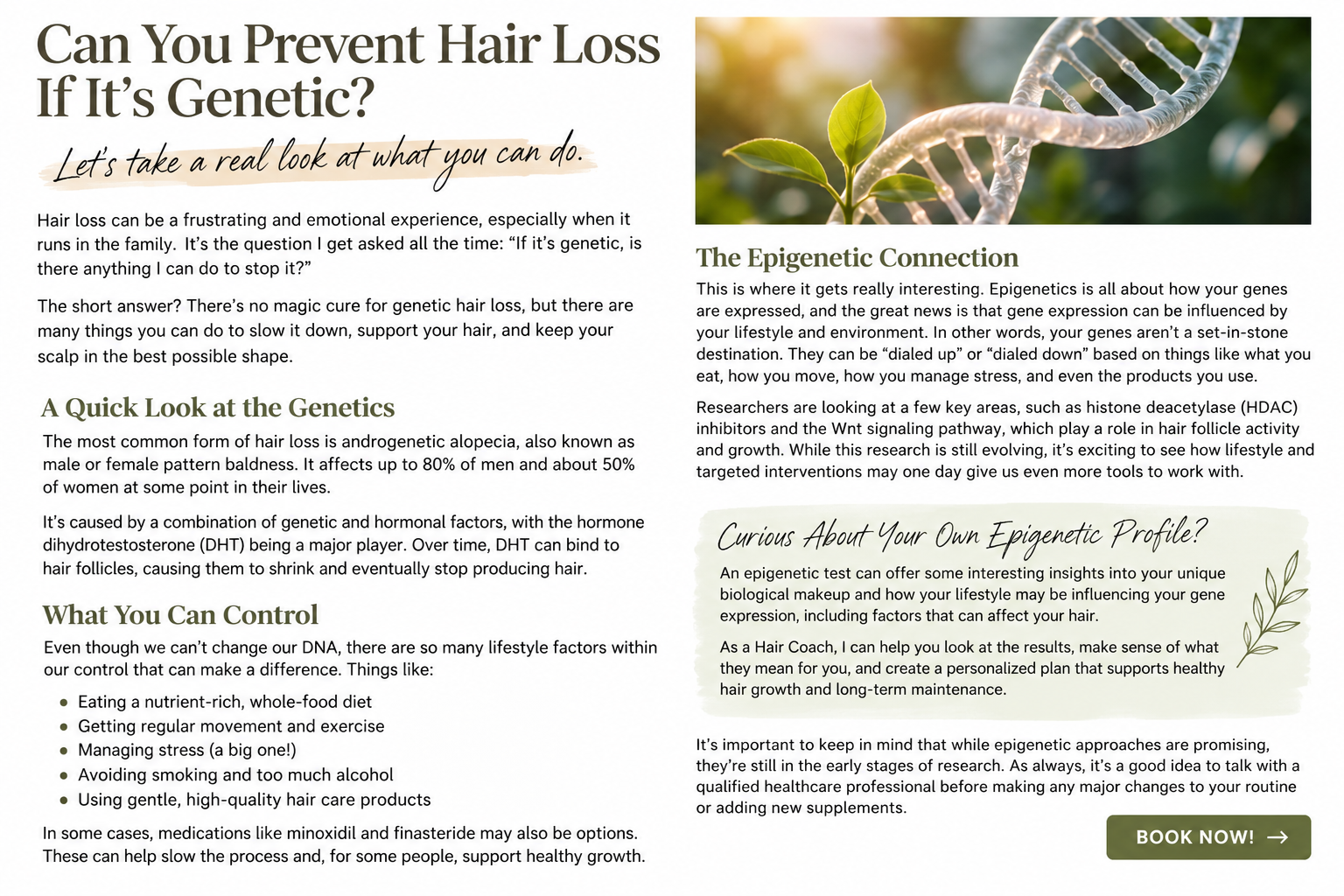
The most common form of hereditary hair loss is called androgenetic alopecia, often referred to as male or female pattern hair loss.
It involves a combination of inherited susceptibility and hormonal influences that gradually change how certain hair follicles function.
Over time, susceptible follicles may produce progressively finer, shorter hairs. This process is called follicular miniaturization.
In men, this often shows up as recession around the temples or thinning at the crown.
In women, it's more commonly noticed as a widening part or reduced density across the top of the scalp, although patterns can vary.
And contrary to popular belief, you don't inherit hair loss exclusively from your mother's side of the family.
Both sides can contribute.
One of the hormones involved is dihydrotestosterone, or DHT. In genetically susceptible follicles, androgen signalling can contribute to miniaturization.
But this doesn't mean everyone experiencing pattern hair loss has unusually high hormone levels.
Sometimes it's about how sensitive the follicles are to those signals.
It's not always about how much of a hormone you have. Sometimes it's about how your body responds to it.
So, If It's Genetic, Can You Actually Do Anything?
Yes. But we need to be realistic about what that means.
We cannot currently change the inherited genetic susceptibility responsible for androgenetic alopecia.
However, genetic hair loss doesn't necessarily progress at the same rate or to the same extent in everyone.
And there are evidence-based treatments that can help slow progression and, in some cases, improve hair growth.
Minoxidil is one commonly used treatment. Finasteride is another option for certain patients, depending on their medical circumstances and prescribing guidance.
These treatments aren't appropriate for everyone, and results vary. They also generally require ongoing use to maintain their benefits.
This is why early recognition matters.
The sooner we understand what's happening, the more opportunity there may be to preserve the hair that's still growing.
Waiting until a significant amount of density has been lost can make treatment more challenging.
Now, Let's Talk About Epigenetics
This is an area that genuinely fascinates me.
And not just because of hair.
Epigenetics explores how gene activity can be regulated without changing the underlying DNA sequence.
Think of your DNA as the instructions you've inherited.
Epigenetic mechanisms help influence how those instructions are used in different cells and circumstances.
Processes such as DNA methylation and histone modification are involved in regulating gene activity.
Our environment, development, ageing and various biological influences can affect epigenetic patterns.
So naturally, the question becomes:
If our environment can influence gene activity, could it also influence how our hair follicles behave?
It's a worthwhile question.
And researchers are exploring it.
But there's an important distinction between understanding how epigenetic mechanisms work and having a proven method to manipulate them to prevent hereditary hair loss.
We're not there yet.
What Does Epigenetics Have to Do With Hair Growth?
Hair follicles are remarkably complex little structures.
They're constantly responding to biological signals that influence when hair grows, rests and sheds.
Researchers have identified several molecular pathways involved in follicle development and cycling, including the Wnt/β-catenin signalling pathway.
Epigenetic regulators also play roles in hair follicle biology.
For example, histone deacetylases, commonly called HDACs, help regulate gene activity and have been studied in relation to follicle function.
This has led researchers to investigate whether targeting certain pathways could eventually offer new treatment possibilities.
It's fascinating science.
But I want to be careful here.
Just because a pathway is involved in hair growth doesn't mean activating or inhibiting it will safely or effectively treat hair loss in humans.
Laboratory findings don't automatically translate into proven treatments.
And HDAC inhibitors are not established treatments for preventing androgenetic alopecia.
I think it's important to be excited about emerging research without getting ahead of the evidence.
There's already enough confusion in the hair-loss industry. We don't need to add to it.
What About Diet, Stress and Lifestyle?
This is where I like to look at the bigger picture.
Your genetics may influence your susceptibility to pattern hair loss, but your overall health can also affect your hair.
Nutritional deficiencies, certain medical conditions, medications, significant stressors and hormonal changes may contribute to additional shedding or changes in hair quality.
For example, someone with androgenetic alopecia could also experience telogen effluvium, a form of increased shedding that may follow a significant physical or physiological stressor.
Now we have two different processes happening at once.
And treating them as though they're the same problem can lead to a lot of wasted time and frustration.
Supporting your general health through adequate nutrition, sleep, appropriate physical activity and stress management makes sense.
But I wouldn't tell someone that eating better or managing stress will switch off their inherited tendency toward androgenetic alopecia.
That's not what the evidence tells us.
Healthy habits support the person. They don't automatically override genetics.
And sometimes the most useful thing we can do is identify which influences are actually relevant rather than assuming everything is connected.
Can an Epigenetic Test Tell You Why You're Losing Hair?
This is another area where I think we need to ask better questions.
There are commercial tests that claim to provide information about epigenetic patterns, biological ageing or lifestyle-related influences.
But these tests vary considerably in what they measure, how they've been validated and what conclusions can reasonably be drawn from their results.
At present, there isn't an established clinical epigenetic test that can reliably tell someone why they have androgenetic alopecia or determine a personalized treatment that will prevent it.
And an epigenetic test is not the same as a genetic test.
For someone experiencing hair loss, a detailed history, scalp examination, trichoscopy and appropriate medical investigation may provide far more useful information.
That doesn't mean research into epigenetics has no value.
It means we need to distinguish between interesting biological information and information that's clinically useful for making decisions.
That's a distinction I take seriously.
What I Look at Before We Start Talking About Solutions
When someone comes to me concerned about hereditary hair loss, I don't want to jump straight to a product or treatment.
I want to understand what's actually changing.
Are you experiencing increased shedding?
Is your ponytail becoming smaller?
Are the individual hairs becoming finer?
Is your part widening?
Have you noticed changes in your scalp?
When did it start, and has anything else changed around the same time?
Your family history matters, but so does your personal history.
Depending on what we're observing, we may need to explore whether the concern is primarily genetic, related to another hair-loss condition or influenced by more than one factor.
And sometimes that means working alongside a physician or dermatologist.
Because understanding the follicle is only one part of understanding the person.
Genetics May Influence Your Hair. They Don't Have to End the Conversation.
I don't believe in promising people that they can reverse their genetics.
And I'm not interested in selling the idea that every hair concern can be solved with the right supplement, serum or lifestyle hack.
What I do believe in is understanding what's happening, recognizing what we can influence and making informed decisions based on the best available evidence.
Epigenetics is an exciting part of that bigger conversation, and I'm looking forward to seeing where the research takes us.
In the meantime, we already have valuable tools for assessing hair loss, identifying contributing factors and exploring appropriate treatment options.
And that's where I prefer to begin.
With observation. With understanding. And with a plan that makes sense for you.
Not Sure Whether Your Hair Loss Is Genetic?
If you've noticed thinning, increased shedding or changes in your hair density, you don't have to figure it out by yourself.
Through The Hair Coach, I offer personalized education and guidance to help you better understand your hair and scalp concerns.
If you're looking for help making sense of your routine, treatment options or next steps, hair coaching may be a good fit.
For persistent or unexplained hair loss, a Comprehensive Trichology Assessment, available in person or virtually, allows us to explore your history, concerns and potential contributing influences more thoroughly. Where appropriate, I can also recommend further medical evaluation.
And if you're not sure where to begin, you're welcome to book a complimentary 15-minute discovery call.
Because your genetics may be part of your story, but understanding what's happening is how you make informed choices about what comes next.
Kerri Jarrett
Certified Trichologist | Red Seal Hairstylist | Educator
Explore Hair Loss Education | Book a Discovery Call | Explore Trichology Assessments


Let’s Talk Hair.
Hair loss. Scalp health. Hair growth. Hair fibre. Hair care. Get evidence-informed education, practical insights and new resources delivered to your inbox—designed to help you better understand what your hair and scalp may be telling you and make more informed decisions about what comes next. Because better questions lead to better answers.


