Hair Density vs Hair Loss: Why Your Hair Feels Thinner
Loss of Hair Density & Mass
Is Your Hair Thinning, Breaking or Simply Losing Fullness?
Why your hair may feel less full, how the hair fibre influences volume, and when it's time to look beyond your hair care routine.
By Kerri Jarrett | Certified Trichologist, Red Seal Hairstylist & Educator
Have you ever pulled your hair into a ponytail and thought, I'm sure this used to be thicker?
Maybe your ponytail feels smaller. Your ends look thinner. Or you're noticing more scalp than you remember seeing before.
Naturally, the first thought is often, Am I losing my hair?
And maybe you are.
But here's something I wish more people understood.
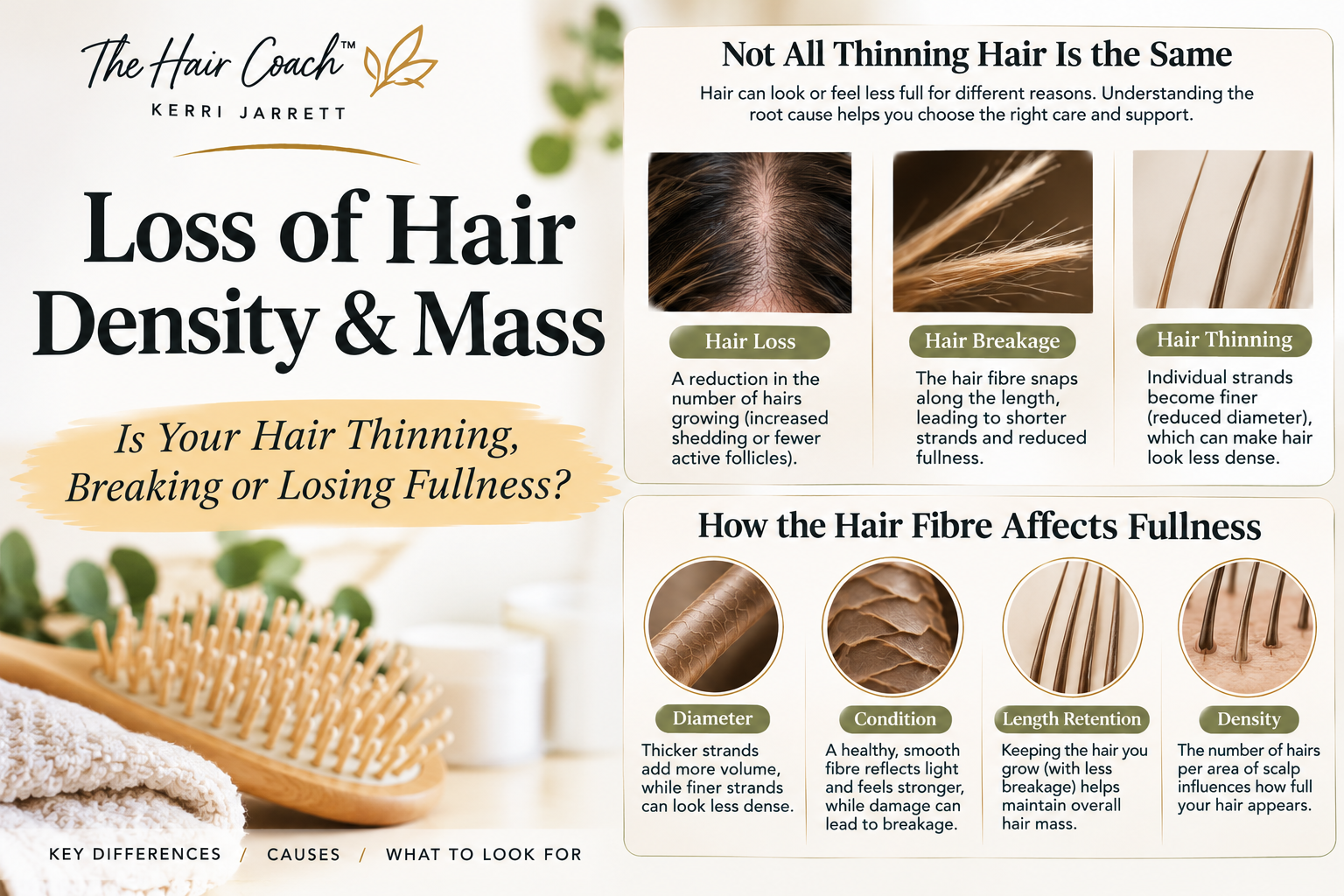
Hair that looks thinner isn't necessarily the same as hair that's falling out.
Sometimes you're losing more hairs than usual. Sometimes the individual hairs are becoming finer. And sometimes you're growing plenty of hair, but it's breaking before it reaches the length you want.
These situations can look surprisingly similar in the mirror.
But they're not the same thing, and they don't necessarily need the same solution.
So before we start talking about hair growth products, let's look at what actually creates the appearance of fullness.
What Makes Hair Look Full?
When we talk about thick hair, we tend to lump several different characteristics together.
But there are a few important distinctions.
Hair density refers to the number of hairs growing within a particular area of the scalp.
Hair diameter refers to the thickness of an individual hair strand.
Hair mass describes the collective amount of hair fibre present. In everyday hair care, we often use the term when talking about overall fullness, bulk or the size of a ponytail.
And then there's length retention, which is how much of your growing hair you're able to keep without losing it to breakage.
All four can influence what you see in the mirror.
Think about two people who have a similar number of hairs growing from their scalp.
One has relatively fine individual strands. The other has thicker strands.
Even with a similar hair count, their ponytails may feel very different.
Now imagine someone with thick individual strands who experiences significant breakage through the lengths.
Their scalp may still have good coverage, but their ends could look thin and uneven.
Fullness is about more than how many hairs are growing.
That's why I don't automatically treat every complaint of thinning as hair loss.
Hair Loss, Hair Thinning and Hair Breakage: What's the Difference?
This is probably the most important part of the conversation.
Hair Loss: When Hairs Are Being Shed or No Longer Produced
Hair loss involves changes in the hair growth cycle, hair shedding or the ability of follicles to produce hair.
Some shedding is completely normal. Hair naturally moves through growth, transition, resting and shedding phases.
But when shedding increases significantly, or when fewer hairs are actively growing, you may notice a reduction in scalp coverage or overall density.
Hair loss can have many contributing factors, including genetics, hormonal influences, medical conditions, medications and certain forms of inflammation.
Some conditions cause temporary shedding. Others involve progressive changes in the follicles.
And not every type of hair loss is permanent.
That's why identifying the pattern matters.
Hair Thinning: When Individual Strands Become Finer
Sometimes the concern isn't simply the number of hairs.
It's their diameter.
In conditions such as androgenetic alopecia, susceptible follicles can gradually produce finer, shorter hairs through a process called follicular miniaturization.
You may still have hair growing in an area, but those hairs contribute less to the overall appearance of coverage and fullness.
A reduction in fibre diameter can make a noticeable difference.
And unlike breakage, this change begins at the follicle, where the hair is produced.
That's an important distinction.
Hair Breakage: When the Fibre Snaps Along Its Length
Breakage happens to the hair shaft after it has emerged from the scalp.
The follicle may be producing hair normally, but the fibre becomes damaged or weakened and snaps.
Chemical processing, excessive heat, mechanical friction and certain styling habits can all contribute.
You may notice shorter strands, uneven lengths, thin-looking ends or hair that never seems to get any longer.
But that doesn't automatically mean the follicles have stopped growing hair.
Your hair may be growing perfectly well. You just might not be keeping all the length.
And that's a very different problem to solve.
How Does the Hair Fibre Affect Density?
Here's where my cosmetology and trichology worlds really come together.
Technically, the hair fibre doesn't determine how many follicles you have or how many hairs are growing from your scalp.
But it absolutely influences how dense your hair appears.
Let's look at how.
1. Hair Diameter Changes the Amount of Fibre You See
A thicker strand contains more material than a finer strand of the same length.
When you have thousands of hairs growing together, those differences add up.
That's why someone can have a relatively high number of fine hairs and still feel that their hair lacks volume.
And someone with fewer, thicker hairs may have a surprisingly substantial ponytail.
Fine hair isn't automatically unhealthy.
It's simply one characteristic of the fibre.
The question is whether your strands have always been fine or whether they've become progressively finer.
2. Breakage Reduces Fullness Through the Lengths
Imagine your hair is growing from the scalp, but the mid-lengths and ends are constantly breaking.
You may still have good coverage near the roots.
Yet the farther down the hair you look, the less fibre remains.
This is why some people have a full-looking crown but very thin ends.
It's not necessarily that fewer hairs are growing.
It's that fewer intact strands are reaching the same length.
And this is where understanding hair breakage, fragile hair and split ends becomes so important.
3. Damage Changes How Hair Behaves
The cuticle and cortex help determine how the hair responds to brushing, styling, water and everyday stress.
When the fibre is damaged, it may become rougher, weaker, more prone to tangling or less able to tolerate stretching.
That can increase the likelihood of further breakage.
The result may be a gradual reduction in retained hair mass, even when growth at the scalp continues.
4. Styling and Product Choices Change Perceived Volume
Sometimes hair appears flatter simply because of how it's being styled or conditioned.
Heavy products, buildup, certain haircuts and styling techniques can reduce visible lift and movement.
That's a cosmetic volume concern, not necessarily a change in hair density.
On the other hand, volumizing products can temporarily make hair look fuller without increasing the number of hairs growing.
Both effects are real.
We just need to be clear about what they're actually changing.
Why Does My Ponytail Feel Smaller?
This is one of those observations I always pay attention to.
A smaller ponytail can be a useful clue, but it doesn't tell us the cause on its own.
It might reflect increased shedding.
It might reflect a reduction in individual hair diameter.
It could be breakage through the lengths.
Or it could involve a combination of those things.
Haircuts, layering, length and even how tightly you gather your hair can influence the comparison.
If your ponytail has gradually become noticeably smaller, especially without a significant haircut or change in styling, it's worth exploring.
I would want to know when you first noticed it, whether your shedding has changed, and whether the hair feels different near the roots compared with the ends.
Those details can help us decide what to examine next.
How Can You Tell Whether You're Shedding or Breaking Hair?
Start by paying attention to the pattern.
With increased shedding, you may notice more full-length hairs coming away during washing, brushing or throughout the day.
With breakage, you may see shorter pieces of varying lengths, particularly where the hair has experienced chemical, thermal or mechanical stress.
But here's an important caution.
You cannot reliably identify every shed hair or broken hair simply by looking at its length.
Naturally short hairs can shed, and long hairs can break.
The presence or absence of a visible bulb at one end may provide a clue, but it isn't a complete diagnosis.
I prefer to look at the overall pattern, scalp coverage, fibre condition, hair history and, when appropriate, trichoscopic findings.
Because what ends up in your hairbrush is only one part of the story.
What Can Cause a Loss of Hair Mass?
There are several possibilities, and they don't all originate in the same place.
Genetics and Hormonal Influences
Genetic predisposition and hormonal signalling can influence hair follicle activity and fibre diameter.
Androgenetic alopecia is one example where progressive miniaturization can affect the appearance of density.
Changes during pregnancy, postpartum recovery, menopause and other hormonal transitions can also influence hair cycling.
But I wouldn't assume every change in density is hormonal.
Nutritional and Medical Factors
Certain nutritional deficiencies, illnesses, medications and medical conditions can contribute to changes in hair growth or shedding.
Iron deficiency, thyroid disorders and other health concerns may be relevant in some cases.
That doesn't mean everyone with thinner hair needs supplements.
And taking high doses of nutrients without identifying a deficiency isn't a sensible hair growth strategy.
When appropriate, medical evaluation and targeted testing can help clarify whether an underlying issue is contributing.
Stress and Changes in the Hair Growth Cycle
Significant physical or psychological stress can influence hair cycling in some people.
For example, telogen effluvium may occur after illness, surgery, major physiological stress or other triggers.
The increase in shedding often becomes noticeable weeks to months after the event.
But stress shouldn't become a catch-all explanation for every hair concern.
We still need to consider the pattern and other possible causes.
Chemical and Heat Damage
Bleaching, colouring, chemical straightening and repeated high-temperature styling can compromise the hair shaft.
These exposures may not reduce the number of follicles, but they can increase breakage and reduce retained length.
That's how fibre damage can create the appearance of thinning without necessarily causing follicular hair loss.
Tight Hairstyles and Repeated Tension
Tight ponytails, braids, extensions and other styles that repeatedly pull on the hair can contribute to traction alopecia.
This is an important exception because styling practices can affect the follicles themselves, not just the hair shaft.
Early changes may improve when tension is removed, but prolonged traction can sometimes cause lasting follicular damage.
That's why persistent tenderness, bumps, thinning around the hairline or repeated tension shouldn't be ignored.
Scalp Conditions
Inflammatory or other scalp disorders may influence hair growth and shedding.
Persistent redness, scaling, discomfort or patchy loss deserves closer evaluation.
And if there is concern about a scarring form of alopecia, timely medical assessment is particularly important.
Can Hair Products Increase Density?
This is where I want people to understand what they're buying.
There are products designed to create volume.
There are products designed to reduce breakage.
And there are evidence-based treatments that can influence hair growth in certain conditions.
Those are three very different categories.
A volumizing mousse can make fine hair look fuller.
A conditioner or strengthening treatment may help reduce friction and improve the performance of damaged lengths.
But neither necessarily increases the number of active hair follicles.
And a product marketed as a hair growth treatment should be evaluated according to its ingredients, evidence, intended use and the condition it's supposed to address.
You can't condition your way out of follicular miniaturization. And you can't treat a split end by stimulating the scalp.
We need to match the solution to the actual concern.
What Can You Do If Your Hair Is Losing Fullness?
Before changing everything, figure out where the change seems to be happening.
If Your Hair Is Breaking
Focus on protecting the fibre.
Review chemical processing, heat styling, brushing habits and conditioning.
Reduce unnecessary friction and tension.
If the ends are severely compromised, a maintenance cut or my SOS Cut may help preserve healthier lengths while removing damaged portions.
This is where personalized hair coaching can be especially helpful.
If Your Individual Strands Seem Finer
Consider whether your hair has always been fine or whether the diameter appears to have changed over time.
Progressive changes, particularly around the part, crown or hairline, deserve assessment.
A trichoscopic examination can help identify patterns of variation in hair shaft diameter and other findings that may warrant medical evaluation.
If You're Experiencing Increased Shedding
Pay attention to the timing, duration and pattern.
Think about recent illness, medication changes, significant stressors or other relevant health events.
If shedding is persistent, substantial or accompanied by visible changes in scalp coverage, don't rely on supplements or cosmetic products alone.
Seek an appropriate assessment.
If Your Hair Just Looks Flat
Sometimes a few adjustments to your haircut, cleansing routine, product selection or styling technique can make a noticeable difference.
Not every volume concern requires a clinical investigation.
But if the change is new, progressive or unexplained, don't dismiss it as simply needing better styling.
Why I Look at the Scalp, Follicle and Fibre Together
This is the foundation of how I approach hair concerns.
The scalp provides the environment surrounding the follicles.
The follicle produces the hair and determines many of its characteristics, including growth activity and diameter.
The fibre is what we see, touch, colour, cut and style.
Each gives us different information.
If someone comes to me with thin-looking ends, I want to examine the condition of the fibre.
If their part is widening or their scalp is becoming more visible, I want to investigate possible changes in hair density and follicular activity.
And if both are happening, we need to address both.
Because sometimes the solution is better hair care.
Sometimes it's identifying a hair loss condition.
And sometimes it's a combination of cosmetic care and medical management.
The important part is knowing which problem we're actually trying to solve.
When Should You Book a Hair and Scalp Assessment?
I'd encourage a closer look if you're noticing:
A progressively widening part or more visible scalp.
A noticeable reduction in ponytail thickness without an obvious explanation.
Persistent or increased shedding.
Thinning around the hairline, temples or crown.
Patchy hair loss.
Significant breakage that doesn't improve with changes to your routine.
Scalp discomfort, inflammation or persistent scaling.
Sudden patchy loss, rapidly progressing changes or signs of scalp inflammation should be assessed promptly by an appropriate healthcare professional.
A trichology assessment can help document your history, examine the scalp and hair, identify patterns and determine whether medical referral or further testing is appropriate.
It isn't a substitute for medical diagnosis, but it can be an important step toward understanding what is happening.
Your Hair May Be Telling You More Than One Thing
I've spent years helping people work with the hair they have, and one thing I've learned is that fullness isn't always as straightforward as it looks.
A person can have healthy follicles and damaged lengths.
They can have relatively strong fibres but fewer hairs growing.
They can have naturally fine hair that is perfectly healthy.
Or they can be experiencing more than one concern at the same time.
That's why I don't believe in treating every complaint of thinning with the same shampoo, serum or supplement.
As a Red Seal Hairstylist and Certified Trichologist, I bring together cosmetology, hair fibre assessment and evidence-informed education to help you understand what's changing.
If your main concern is breakage, thin-looking ends, styling or length retention, personalized hair coaching can help you build a practical plan to protect the hair you're growing.
If you're experiencing unexplained shedding, progressive thinning, visible changes in scalp density or scalp symptoms, a Comprehensive Trichology Assessment, available in person or virtually, may be a better starting point.
And if you're unsure which direction makes sense, you're welcome to book a complimentary 15-minute discovery call.
Because before we try to make your hair fuller, we need to understand why it feels less full in the first place.
Kerri Jarrett
Certified Trichologist | Red Seal Hairstylist | Educator
Explore Hair Fibre Education | Explore Hair Coaching | Book a Complimentary Discovery Call


Let’s Talk Hair.
Hair loss. Scalp health. Hair growth. Hair fibre. Hair care. Get evidence-informed education, practical insights and new resources delivered to your inbox—designed to help you better understand what your hair and scalp may be telling you and make more informed decisions about what comes next. Because better questions lead to better answers.


