
Telogen Effluvium
When the Hair Cycle Gets Interrupted: Understanding Telogen Effluvium
One of the most common things I hear from people experiencing telogen effluvium is, “My hair just suddenly started falling out.”
And from their perspective, that is exactly what it feels like.
One day everything seems relatively normal, and then suddenly there is hair everywhere. More in the shower, more in the brush, more on your clothes and more coming away when you run your hands through it. Before long, you’re paying attention to every wash day and mentally counting hairs without even meaning to.
Naturally, the question becomes: Why is this happening?
Telogen effluvium, often shortened to TE, is a form of excessive hair shedding. But I think it makes much more sense when we stop looking only at the hair coming out today and start looking at the hair-growth cycle that came before it.
Because that hair didn’t suddenly decide to fall out this morning.
Its story started weeks, and often months, earlier.
Understanding the Hair-Growth Cycle
Hair grows in cycles. Each follicle is its own little biological system, moving independently through periods of growth, transition, rest and eventually shedding.
The longest part of that cycle is anagen, the active growing phase. This is when the follicle is actively producing the hair fibre. Normally, the majority of the hairs on the scalp are somewhere within this phase. Thankfully, our follicles don’t all follow exactly the same schedule. One may be actively growing while another is transitioning and another is preparing to release its hair.
That staggered cycling is part of what allows us to maintain relatively consistent hair density even though we naturally shed hair every day.
Eventually, a hair leaves active growth and enters catagen, a much shorter transitional phase. Cellular activity begins to slow, the lower portion of the follicle regresses and the relationship between the growing hair and the structures that supported its active growth begins to change.
From there, the follicle moves into telogen, the resting phase, and eventually the hair is released during the shedding process, often referred to as exogen.
This is why I love showing the hair-growth cycle visually. When you actually see how the follicle changes through these stages, telogen effluvium starts to make considerably more sense.
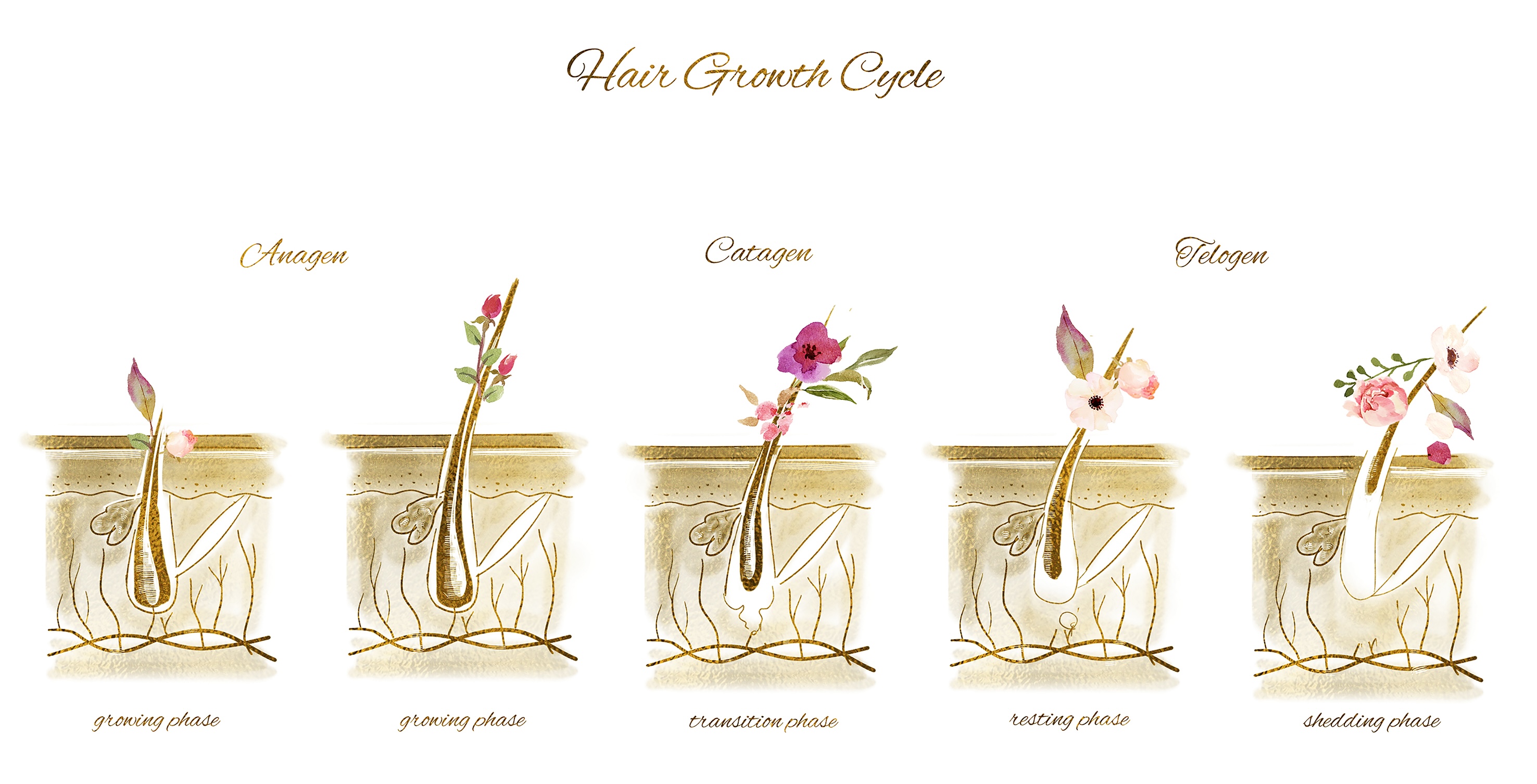
I also think it is worth paying attention to what happens to the root, or bulb, of the hair throughout this process.
A hair in active anagen doesn’t look the same at its root as a naturally shed telogen hair. As the follicle moves out of active growth, the lower portion changes and the hair eventually develops the characteristic club-shaped root we associate with a telogen hair.
Even that tiny little bulb on the end of a shed hair can give us information.
It’s one of the reasons I’m always saying that hair is communicating with us. The trick is learning what we’re actually looking at.
So What Happens With Telogen Effluvium?
Under normal circumstances, your follicles aren’t synchronized. They’re doing their own thing on slightly different timelines, which is exactly what we want.
With telogen effluvium, something interrupts that normal rhythm and a larger-than-usual number of follicles shift out of active growth and toward telogen within a similar period of time.
But—and this is an important part—they don’t necessarily fall out immediately.
Those hairs still have to move through the biological process that eventually leads to shedding. This creates a delay between whatever influenced the hair cycle and the hair you eventually notice coming out.
That delay is one of the most important things I want people to understand about telogen effluvium.
Someone may come to see me in September because their hair suddenly started shedding. Naturally, they start looking at what happened last week or what shampoo they recently changed.
I’m usually much more interested in going backwards.
When did you first notice the shedding? Now, what was happening before that?
Depending on the situation, I may be looking several weeks or several months back. Illness, fever, surgery and other physiological disruptions, for example, may influence the hair cycle well before the resulting shedding becomes obvious.
This is why the timeline becomes such an important part of how I assess hair loss.
The shedding may be happening now.
The event that influenced the cycle may not be.
Your Hair Can Be a Delayed Messenger
This is probably one of my favourite things to teach people about hair because once you understand it, you start investigating shedding very differently.
Instead of only asking, “What did I change recently?” we start asking, “What was happening in my body and my life before the shedding began?”
Maybe there was a significant illness or fever. Perhaps there was surgery, rapid weight loss, a major dietary change or a period when nutritional intake wasn’t meeting the body’s needs. Pregnancy and postpartum changes can influence the cycle. So can hormonal changes, starting or stopping certain medications, and periods of significant physiological or emotional stress.
And sometimes there isn’t one dramatic event we can circle on a calendar.
Sometimes several smaller things are happening at once.
I’ve had people initially tell me, “Nothing happened.”
Then we start building the timeline. We talk. We go backwards. And eventually there is an, “Oh…wait.”
That moment matters, because telogen effluvium isn’t simply about hair falling out. Something influenced the cycle. My job is to help understand what that something might have been, and whether it is over, still happening or perhaps only one piece of a bigger picture.
Why I Don’t Love Calling It “Stress Hair Loss”
Stress absolutely can be associated with telogen effluvium, but I think we’ve made the word stress so broad that sometimes it stops us from asking better questions.
When most people hear “stress,” they immediately think about emotional stress. Work. Relationships. Grief. Anxiety. Being overwhelmed.
Those things matter, but the body can experience physiological stress too.
Illness places demands on the body. So can a high fever, surgery, significant nutritional restriction, rapid weight loss and major hormonal changes. Pregnancy and the postpartum period can dramatically alter normal hair cycling. Changes associated with perimenopause, menopause, thyroid function and hormonal medications may also be relevant when we’re looking at changes in the hair.
So when someone tells me, “My doctor said my hair loss is probably stress,” my next thought isn’t necessarily that they need to relax more.
My next question is:
What does stress mean in this person’s body?
That gives us somewhere useful to begin.
What Does Telogen Effluvium Actually Look Like?
Telogen effluvium generally presents as diffuse shedding rather than one perfectly defined patch of hair loss. Many people first notice it during washing because suddenly the amount of hair in their hands or shower looks completely different from what is normal for them.
Over time, they may notice their ponytail feels smaller, their overall density looks different or they can see more scalp than they used to. But this is where we need to be careful, because excessive shedding doesn’t automatically equal telogen effluvium. Hair-loss conditions don’t always read the textbook before showing up. Sometimes more than one thing is happening at the same time. Someone can experience a telogen effluvium episode while also having underlying androgenetic alopecia, for example. The sudden shedding may make density changes that were already developing much more noticeable.
This is why I don’t diagnose hair loss by counting hairs in someone’s shower drain.
We need context. We need the pattern. We need the timeline. And we need to look at the hair and scalp themselves.
Will the Hair Grow Back?
Understandably, this is one of the biggest questions people have.
In many cases of acute telogen effluvium, the hair can regrow because the follicle itself hasn’t been destroyed. The cycle has been disrupted. The frustrating part is that recovery doesn’t happen at the same speed as shedding.
You can lose a noticeable amount of density relatively quickly, but replacing that density takes time. The follicle has to return to active growth, begin producing another hair and then grow enough length for that new hair to contribute to what you actually see in the mirror.
This is why I separate reduced shedding from visible recovery. They are not the same milestone.
You may notice less hair coming out before your ponytail feels thicker. You may begin seeing small new hairs before your overall density looks different. Even when the original trigger has resolved, the hair still has to work through its biological process. We can support the environment. We can identify obstacles. We can address what needs addressing. But we can’t bully a follicle into ignoring biology. Believe me, the hair-growth industry has certainly tried.
What If the Shedding Doesn’t Stop?
This is where telogen effluvium can become more complicated.
Some episodes are acute and gradually resolve once the triggering event has passed. Others persist, recur or overlap with another hair-loss condition.
If someone continues shedding, I don’t want to keep saying, “It’s TE. Give it time.”
I want to revisit the picture.
Was there actually one triggering event, or have there been several? Is something still ongoing? Does nutrition deserve a closer look? Are there hormonal or thyroid-related symptoms that should be investigated medically? Did medication change? Is there inflammation? Is another type of hair loss occurring alongside the shedding? Has the pattern itself changed?
This is where measuring and tracking become incredibly valuable.
Rather than relying only on “I think it looks better” or “I swear it’s getting worse,” we can compare photographs, density, hair diameter, scalp findings and trichoscopy over time.
Now we have information.
And information is much more useful than guesswork.
Treatment Starts With Understanding What Changed
When someone starts losing hair, the natural instinct is to find something that will make it grow.
A serum. A supplement. A shampoo. Minoxidil. Rosemary oil. Something, anything, that feels like taking action.
But with telogen effluvium, I don’t think the first question should be, “What can we put on the scalp?”
I think the better question is: Why did the cycle change?
If there was an illness and the body has recovered, our conversation may look very different from the conversation I would have with someone who is still experiencing an ongoing physiological stressor.
If the history suggests nutritional insufficiency, that deserves appropriate investigation rather than blindly adding supplements.
If there are signs that make me question thyroid function, hormones, iron status or another health factor, that is where collaboration with the appropriate healthcare professional becomes important.
And if something about the scalp, pattern or hair doesn’t fit telogen effluvium, we don’t force it into that box simply because shedding is present.
That is the part of trichology I love.
We aren’t simply looking at hair.
We’re looking at patterns, timing, biology and context.
How I Approach Telogen Effluvium
When someone comes to me because their hair is shedding, I start with observation and questions. Of course I want to know when you first noticed the change. But once we establish that, I want to go backwards and build the timeline around it.
What was happening with your health in the weeks and months leading up to the shedding? Were there medication changes? Hormonal changes? Illness? Surgery? Dietary changes? Weight loss? Significant stress? Changes in your normal routine? Then I look closely at the hair and scalp themselves.
What does the shedding pattern look like? Has density changed? What are we seeing with hair diameter? What does the scalp look like? What can the roots of the shed hairs tell us? Are there signs of regrowth? And is all of what the person is seeing actually shedding from the follicle, or is hair-fibre breakage contributing to the perceived loss? Those distinctions matter, and sometimes the answer isn’t entirely within the hair.
Part of my role as a trichologist is recognizing when something deserves further medical investigation and helping the person understand what information or questions may be useful to take back to their physician, dermatologist or another healthcare professional.
That is part of getting to the root cause too.
If Your Hair Suddenly Starts Shedding, Start With the Timeline
If there is one thing I want you to take from this article, it is this: Go backwards.
Don’t automatically assume that something you did last week caused the hair you are losing today. And please don’t panic-buy every supplement, serum and hair-growth product the internet decides you need before you understand what you’re actually dealing with.
Start with when you first noticed the change.
Then look at the weeks and months before it.
What changed in your body? What changed in your health? What changed in your life?
Sometimes there is one very obvious event. Sometimes several pieces start connecting once we lay them out on a timeline. And sometimes we don’t immediately find the answer. That is okay too.
The goal isn’t to force every episode of shedding into a neat little explanation. The goal is to observe first, understand the pattern and ask better questions.
Because the hair coming out today may be telling us about something that happened long before you noticed anything was wrong.
And perhaps that is one of the most fascinating things telogen effluvium teaches us about hair:
What we see on the outside today can be the result of a biological process that began weeks or months earlier. Hair has a story.
Sometimes we just need to go backwards to read it.

Keep Exploring Hair Loss
Telogen effluvium is only one possible explanation for excessive shedding or changes in hair density. Androgenetic alopecia, alopecia areata, traction alopecia, scarring alopecia, hormonal influences, nutritional factors and other conditions can sometimes create changes that look surprisingly similar from the bathroom mirror.
Sometimes, more than one thing is happening at once.
→ Explore All Types of Hair Loss
Concerned About Your Own Hair?
You don’t need to know what type of hair loss you have before reaching out. That’s part of what my Comprehensive Trichology Assessment is designed to help us understand.
I look at the pattern and timeline of your hair loss alongside your scalp health, hair growth, hair fibre, hair-care practices and relevant health and lifestyle context. The goal isn’t to squeeze you into a one-size-fits-all answer. It’s to understand the bigger picture, identify what may deserve further investigation and determine appropriate next steps for you.
→ Book a Complimentary 15-Minute Consultation
→ Explore the Comprehensive Trichology Assessment
Related Reading
Hormones + Hair Loss · Nutrition + Hair Health · What Is Trichoscopy?
Educational information only. This article is not intended to diagnose or treat telogen effluvium or any other medical condition. Hair loss can have multiple causes and may require assessment by a physician, dermatologist or other qualified healthcare professional. Medication decisions should always be discussed with the appropriate prescribing healthcare professional


Let’s Talk Hair.
Hair loss. Scalp health. Hair growth. Hair fibre. Hair care. Get evidence-informed education, practical insights and new resources delivered to your inbox—designed to help you better understand what your hair and scalp may be telling you and make more informed decisions about what comes next. Because better questions lead to better answers.


