Frizzy Hair & Environmental Damage
Frizzy Hair & Environmental Damage
Why Your Hair Behaves Differently With the Weather
Humidity, dry air, wind, sun and water quality can all influence your hair. Here's how to understand what's happening without fighting your natural texture.
By Kerri Jarrett | Certified Trichologist, Red Seal Hairstylist & Educator
Have you ever spent half an hour styling your hair, stepped outside, and watched all that hard work disappear?
You leave the house with a beautiful blowout. Then the humidity hits, the wind picks up, or you pull off your winter toque, and suddenly your hair has other plans.
Living in Alberta, I've seen what dry winters, static electricity and changing weather can do to a hairstyle.
And here's what I find interesting.
Two people can walk outside in exactly the same weather and have completely different experiences with their hair.
One person's hair expands and becomes frizzy. Another person's hair falls flat. Someone else ends up with enough static to power a small appliance.
Same environment. Different hair.
That's because the way your hair responds to its surroundings depends on the fibre you're working with.
And before we start trying to fix frizz, I think we need to understand what it actually is.
What Is Frizzy Hair?
Frizz is a description of how hair looks and behaves, not a diagnosis.
It often appears as strands that separate from the main hairstyle, creating a less uniform or less defined appearance.
For someone with straight hair, that might mean flyaways or a fuzzy surface.
For someone with curly or wavy hair, it might mean reduced curl definition, expansion or individual strands moving outside their curl groupings.
But here's something I want to make very clear.
Frizz doesn't automatically mean your hair is damaged, dry or unhealthy.
Some hair naturally has more volume, texture and movement. And not every strand is supposed to lie perfectly flat.
The question isn't whether your hair has frizz.
It's whether that frizz is normal for your hair, something you'd like to manage cosmetically, or a change that may be telling us something about the fibre's condition.
Those are different conversations.
Why Does Humidity Make Hair Frizzy?
Hair interacts with moisture in the surrounding air.
When humidity changes, the amount of water associated with the hair fibre can change too.
Water influences temporary interactions within the hair, including hydrogen bonding, which plays a role in how hair holds its shape.
That's why a hairstyle created with a blow-dryer or flat iron may gradually change when exposed to humid conditions.
The hair begins responding to its environment rather than maintaining the shape you created with heat.
For curly and wavy hair, that may mean more expansion or a return toward its natural pattern.
For straightened hair, it may mean waves or bends reappearing.
And if the fibre has significant surface damage or altered porosity, its response may be more difficult to manage.
Humidity isn't necessarily damaging your hair every time you step outside. Sometimes it's simply changing your hairstyle.
That's an important difference.
What Does Hair Porosity Have to Do With Frizz?
Porosity is one of those hair-care terms that gets thrown around a lot.
Essentially, it describes how readily hair takes up and releases water and other substances.
Hair that has been heavily bleached, chemically processed or physically weathered may have structural changes that affect those interactions.
When the cuticle is compromised, the fibre may also become rougher, more prone to tangling and more vulnerable to additional wear.
That can contribute to persistent frizz.
But not everyone with frizzy hair has high porosity.
And high porosity isn't something we can reliably diagnose by dropping a strand of hair into a glass of water.
I know that test is popular online, but there are too many variables involved for it to provide a dependable assessment.
I prefer looking at the hair's history, condition, behaviour and response to products.
Because one floating strand doesn't tell us much about what your hair has been through.
Why Does My Hair Frizz Even When It's Not Humid?
This is something I hear quite often.
And it's where we need to look beyond the weather.
Your Natural Hair Texture
Curly, coily and wavy hair naturally follows different paths along the fibre.
Individual strands don't always group together uniformly, and some amount of frizz may be part of the hair's natural appearance.
That's not a problem that needs correcting unless you personally want a different finish.
Cuticle Wear and Damage
Chemical processing, repeated heat exposure and mechanical friction can alter the surface of the hair.
When the fibre becomes rougher, strands may catch on one another, tangle more easily and become harder to align during styling.
This can contribute to persistent frizz.
Product Selection
Sometimes the products you're using aren't giving your hair the hold, lubrication or conditioning it needs for the style you're trying to create.
A product that works beautifully for one person's hair may be too heavy, too light or simply unsuitable for another.
Styling Technique
How you dry, brush and handle your hair matters.
For example, repeatedly brushing through dry curls may separate their natural groupings and create more volume or frizz.
That doesn't mean the hair has become damaged.
It may simply mean the technique isn't supporting the finish you're looking for.
What Does Dry Winter Air Do to Your Hair?
Let's talk about winter.
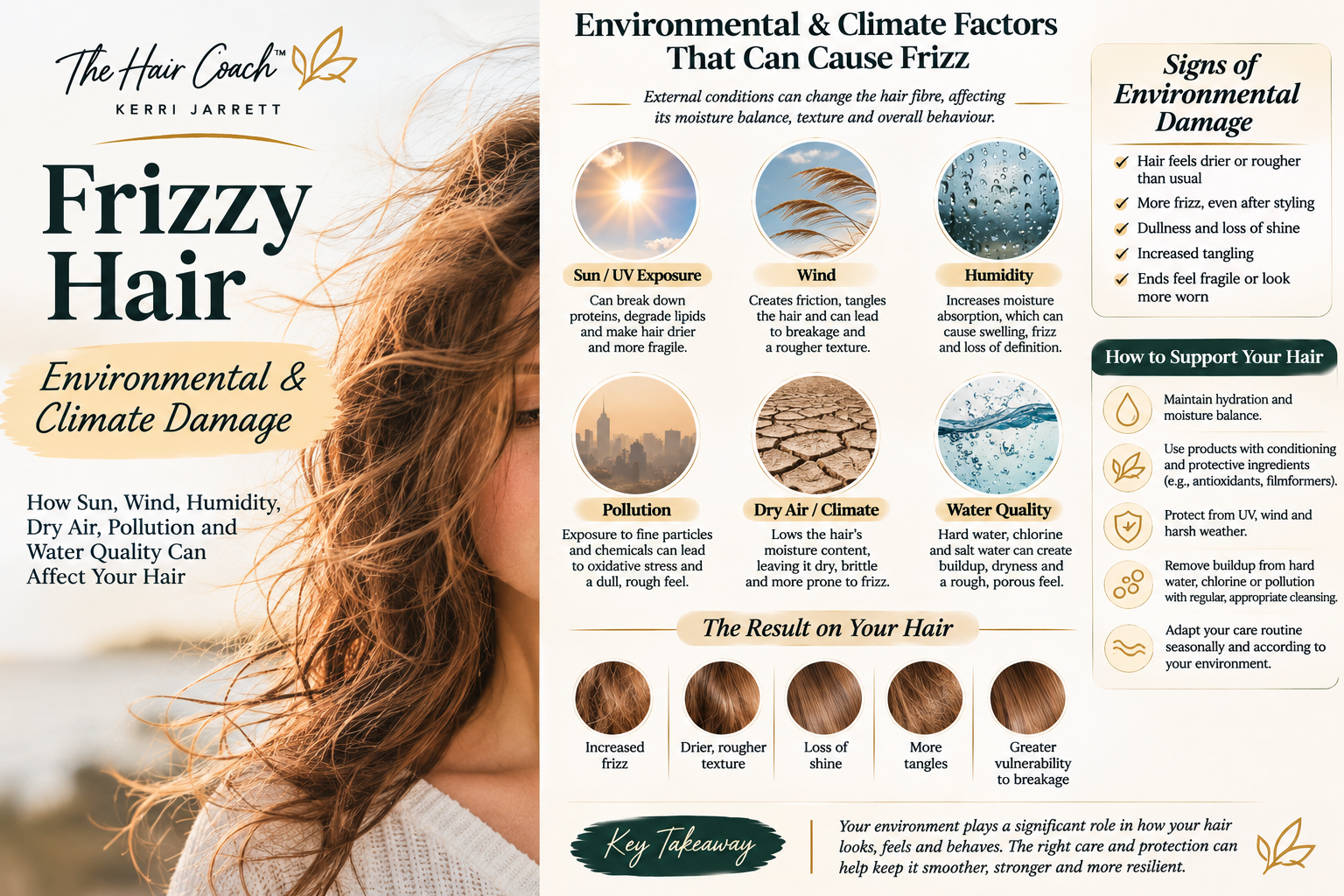
Cold outdoor temperatures, indoor heating and low humidity can change the way hair behaves.
In dry conditions, hair may hold less water and become more prone to static electricity.
That's why you might remove a sweater or toque and suddenly have flyaways everywhere.
Friction from hats, scarves and winter clothing can make the situation more noticeable.
But again, static isn't automatically a sign of damaged hair.
It's often related to the environment, the materials coming into contact with your hair and the fibre's surface properties.
Conditioning products, gentle handling and reducing friction can help.
And sometimes, accepting that winter in Alberta comes with a little static is part of the deal.
How Does Sun Exposure Affect Your Hair?
We talk a lot about protecting our skin from the sun.
But our hair is exposed too.
Ultraviolet radiation can contribute to changes in hair proteins, pigments and surface properties.
Over time, excessive exposure may contribute to colour fading, roughness, reduced strength and increased weathering.
Lightened and colour-treated hair may be especially noticeable when it comes to changes in colour appearance.
And while hair products with UV-protective ingredients may help reduce certain effects, their protection depends on the formulation and how they're used.
A hat or other physical barrier is often a practical option during prolonged sun exposure.
Your scalp also needs appropriate sun protection, particularly where hair coverage is limited.
What About Wind?
Wind doesn't chemically damage hair simply by blowing through it.
But it can contribute to tangling, repeated movement and friction.
If your hair is long, fine, curly or already compromised, those tangles may require more detangling afterward.
And if you're pulling aggressively through knots, that's where additional mechanical damage can occur.
A loose braid, protective hairstyle or gentle detangling routine can help reduce unnecessary stress.
Sometimes prevention is as simple as keeping your hair from becoming one giant knot on a windy day.
Can Pollution Affect Hair Health?
Airborne particles and environmental pollutants can settle on the hair and scalp.
Some pollutants have been studied for their potential to contribute to oxidative stress and other biological effects.
But we need to be careful about assuming that everyday pollution exposure is the direct cause of someone's frizz or hair loss.
The evidence depends on the pollutant, exposure and outcome being studied.
For everyday hair care, appropriate cleansing and reducing unnecessary buildup are sensible starting points.
If you're experiencing persistent scalp irritation or unexplained shedding, that's a different concern that may deserve further investigation.
Does Hard Water Make Hair Frizzy?
Water quality is another factor worth considering.
Hard water contains minerals, particularly calcium and magnesium, that can interact with cleansing products and sometimes contribute to deposits on the hair.
Depending on your hair and routine, you might notice a coated feeling, reduced manageability or changes in how your products perform.
But hard water isn't the explanation for every case of frizz.
And a regular clarifying shampoo isn't necessarily the same as a chelating treatment designed to address certain mineral deposits.
If water quality seems to be contributing, we need to choose an approach that suits the hair's condition rather than repeatedly using aggressive cleansing products.
What About Chlorine, Saltwater and Swimming?
Swimming adds another layer to the conversation.
Pool water, seawater, repeated wetting and drying, and sun exposure can all influence the hair's condition.
Chlorinated pool water may contribute to changes in hair colour or surface properties, particularly with repeated exposure.
Saltwater can also affect the way hair feels and behaves as it dries.
The goal isn't to avoid swimming.
It's to be mindful of the additional exposure.
Rinsing your hair after swimming, using appropriate conditioning products and reducing aggressive detangling can help.
For frequent swimmers, a more specific cleansing and conditioning routine may be appropriate.
How Do You Know If Your Frizz Is Natural or Related to Damage?
This is where I encourage people to pay attention to changes rather than chasing a perfectly smooth finish.
Ask yourself:
Has my hair always behaved this way, or is the frizz new?
Is it concentrated through previously coloured or lightened sections?
Does it become worse in humidity, or is it persistent in every environment?
Am I noticing roughness, tangling or breakage along with it?
Has my natural curl pattern changed?
Do my products seem to help, or do they leave my hair heavy and coated?
Have my styling habits or water conditions changed?
If your hair has always been naturally voluminous or frizz-prone, you may simply need styling techniques that work with its texture.
If the frizz appeared after repeated bleaching or excessive heat, we may need to address structural damage.
And if it's accompanied by significant breakage or unusual changes in hair quality, a closer assessment may be helpful.
The goal isn't to eliminate every flyaway. It's to understand what's changed and why.
How to Manage Frizz Without Fighting Your Hair
You don't need to buy every anti-frizz product on the shelf.
Start with the basics.
Choose Products That Suit Your Hair
Conditioners and leave-in products can help improve lubrication, reduce friction and make hair easier to manage.
Styling products may also help control flyaways, support curl definition or improve humidity resistance.
The right choice depends on your hair's diameter, texture, condition and styling goals.
Be Intentional With Drying
Avoid aggressive towel rubbing.
Gently squeeze or blot excess water, and consider using a smooth towel or soft cotton fabric.
For curls and waves, drying techniques that preserve strand groupings may help maintain definition.
Reduce Unnecessary Heat
Heat can temporarily smooth the hair and create a polished finish.
But repeated high-temperature styling can contribute to long-term damage.
Use suitable heat protection, avoid excessive temperatures and remember that straightening your hair every day isn't necessarily the best way to manage persistent frizz.
Protect Hair From Friction
Pay attention to how your hair interacts with clothing, pillowcases, hats and elastics.
Gentler handling and protective hairstyles can help reduce tangling and unnecessary wear.
Adjust Your Routine With the Seasons
Your hair may behave differently in July than it does in January.
That's normal.
You might need a different amount of conditioning, hold or styling protection depending on humidity and environmental conditions.
You don't necessarily need a completely new product collection every season.
Sometimes a few thoughtful adjustments are enough.
Don't Ignore Damaged Ends
If the ends are split, heavily weathered or breaking, styling products can improve their appearance but won't permanently restore the damaged fibre.
A maintenance trim or my SOS Cut may be helpful when compromised ends are contributing to tangling and breakage.
Can You Permanently Get Rid of Frizz?
That depends on what you mean by frizz.
If it's part of your natural texture, there's nothing inherently unhealthy to eliminate.
You can change how your hair looks through styling techniques and certain chemical services, but those choices come with their own considerations.
If frizz is related to damage, appropriate conditioning and protective care may improve manageability and reduce further wear.
But severely damaged hair cannot biologically regenerate back to its original condition.
And if humidity is affecting a temporary hairstyle, even beautifully conditioned hair may still respond to changes in the air.
The goal should be manageable hair that suits your preferences, not an unrealistic promise that every strand will stay perfectly smooth forever.
When Should You Look Beyond Frizz?
Most frizz concerns are cosmetic and can be addressed through hair care and styling choices.
But if you're experiencing significant breakage, sudden changes in hair quality, increased shedding, visible thinning or scalp symptoms, it's worth looking more closely.
Not every change is caused by humidity or damaged cuticles.
And hair loss is not the same as hair fibre frizz.
If the concern extends beyond styling and manageability, a more thorough assessment may be appropriate.
Your Hair Doesn't Have to Fight the Weather
One of the things I enjoy most about working with hair is helping people understand why it behaves the way it does.
Sometimes it's about finding a better styling technique.
Sometimes it's choosing products that make sense for your texture.
Sometimes it's protecting the fibre from damage.
And sometimes it's recognizing that your natural hair isn't doing anything wrong.
As a Red Seal Hairstylist and Certified Trichologist, I approach hair from both the cosmetic and structural sides.
If you're frustrated with persistent frizz, product choices or styling that never seems to last, personalized hair coaching can help you understand your hair and build a practical routine.
If you're experiencing unexplained changes in hair quality, significant breakage, unusual shedding or scalp concerns, a Comprehensive Trichology Assessment, available in person or virtually, may be a more appropriate starting point.
And if you're unsure where to begin, you're welcome to book a complimentary 15-minute discovery call.
Because your hair doesn't need to behave like someone else's to be healthy. You just need to understand how to work with it.
Kerri Jarrett
Certified Trichologist | Red Seal Hairstylist | Educator
Explore Hair Fibre Education | Explore Hair Coaching | Book a Complimentary Discovery Call


Let’s Talk Hair.
Hair loss. Scalp health. Hair growth. Hair fibre. Hair care. Get evidence-informed education, practical insights and new resources delivered to your inbox—designed to help you better understand what your hair and scalp may be telling you and make more informed decisions about what comes next. Because better questions lead to better answers.


