Fragile Hair
Fragile Hair: Why Your Hair Feels Weak and What You Can Do About It
By Kerri Jarrett | Certified Trichologist, Red Seal Hairstylist & Educator
Does your hair feel like it breaks just by looking at it?
Maybe you’ve noticed more little pieces of hair around the bathroom sink. Your ends feel rough no matter how much conditioner you use. Or your hair simply doesn’t seem to tolerate the brushing, styling or colouring it once did.
These are things I’ve heard countless times behind the chair.
And while it’s tempting to reach for another strengthening treatment, I always like to start with a different question:
What’s making your hair fragile in the first place?
Because not all fragile hair is the same, and understanding what’s happening can save you a lot of frustration, unnecessary products and potentially more damage.
What Exactly Is Fragile Hair?
Fragile hair is hair that has become more vulnerable to damage or breakage. It may feel delicate, rough, brittle or unusually difficult to manage.
Sometimes the hair has been weakened by chemical processing or excessive heat. Other times, it’s the accumulation of everyday habits that gradually wear down the fibre.
And sometimes, the hair itself is naturally fine or has characteristics that make it less tolerant of certain styling practices.
Here’s something worth understanding: fine hair and fragile hair are not the same thing.
Fine hair describes the diameter of an individual strand. Fragility describes how easily that strand becomes damaged or breaks.
You can have fine hair that’s in excellent condition, just as you can have coarse hair that’s severely compromised.
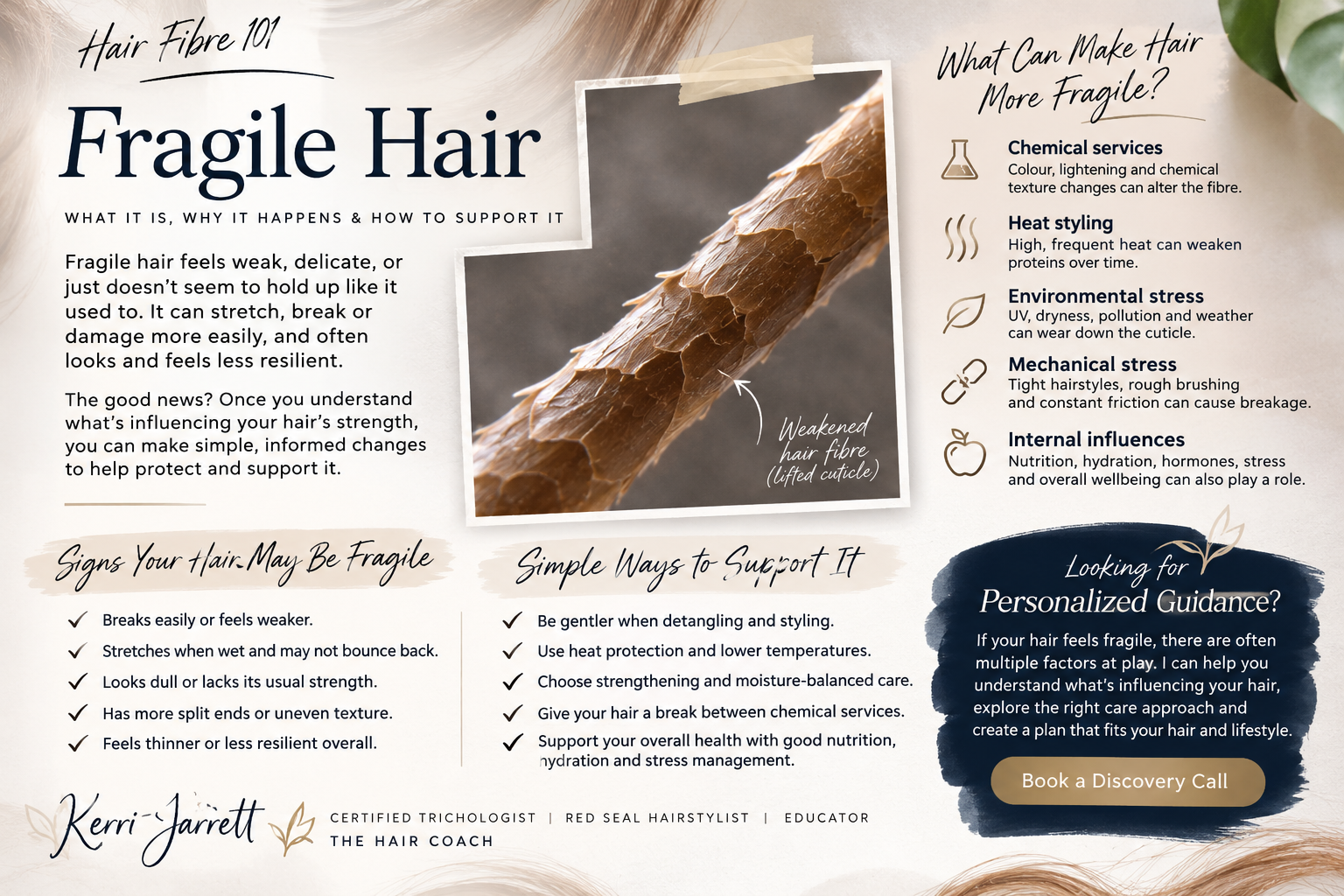
What’s Actually Happening Inside the Hair?
Your hair fibre has several structural components, but two are especially important when we’re talking about fragility.
The cuticle is the outer protective layer. Think of it as overlapping scales that help protect the inner structure of the hair.
The cortex makes up much of the hair’s internal structure. It contains keratin proteins and contributes significantly to the fibre’s strength, elasticity and physical properties.
When the cuticle becomes worn or damaged, the hair may experience increased friction, tangling and vulnerability to further wear.
More significant damage can affect the cortex, reducing the hair’s ability to tolerate tension and stretching.
This is why hair can sometimes feel surprisingly soft or stretchy when wet, yet break easily. Other hair may feel stiff, rough and snap with very little movement.
Different behaviours. Different underlying problems.
And potentially different care needs.
What Makes Hair Fragile?
Usually, there isn’t one single culprit. It’s often a combination of influences that build up over time.
Chemical Processing
Colouring, lightening, perming and chemical straightening can change the hair’s structure. Lightening in particular can affect proteins and protective components of the fibre.
That doesn’t mean you need to stop colouring your hair. It means your chemical history, processing frequency and the condition of your hair should guide what happens next.
Heat Styling
Blow-dryers, flat irons and curling tools can contribute to damage, especially when temperatures are excessive or the same sections are repeatedly exposed.
Heat protection helps reduce certain forms of damage, but it doesn’t make hair invincible.
Mechanical Wear and Tear
Brushing, detangling, tight hairstyles, extensions, rough towel drying and friction against clothing or bedding can all contribute to breakage.
One of the things I often remind people is that hair doesn’t have to be chemically processed to become damaged.
Sometimes it’s simply been through a lot.
Environmental Exposure
Sunlight, wind, humidity changes, swimming pools and certain water conditions can influence the hair’s surface, manageability and overall condition.
Environmental exposure may not be the only cause of fragility, but it can add to damage that’s already there.
Your Hair’s Individual Characteristics
Hair diameter, curl pattern, previous damage and natural variation all influence how hair responds to styling and handling.
That’s why copying someone else’s routine doesn’t always work.
Your hair has its own history.
How Do You Know If Your Hair Is Fragile?
Some common signs include:
Hair that snaps during brushing or styling.
Rough, frayed or split ends.
Increased tangling and difficulty detangling.
A dull appearance or reduced shine.
Hair that feels unusually brittle or excessively stretchy.
Shorter broken strands appearing throughout the lengths.
But here’s where observation becomes important.
Not every short hair is a broken hair. Some are new growth.
Not every strand that comes out in your brush has snapped. Some have shed naturally.
And not every person experiencing reduced hair fullness has a fibre problem.
Breakage, shedding and thinning are three different things, even though they can look similar at first.
Understanding which one you’re dealing with changes the conversation entirely.
Can Fragile Hair Become Stronger Again?
This is where hair care marketing can get a little carried away.
There are some excellent conditioning and strengthening technologies available, including products designed to improve lubrication, reduce friction, reinforce damaged areas or improve certain mechanical properties of the hair.
These can make a meaningful difference in how your hair looks, feels and behaves.
But hair outside the scalp is not living tissue capable of healing itself.
Once the fibre has been structurally damaged, it cannot biologically regenerate back to its original condition.
So when we talk about improving fragile hair, we’re generally working toward three goals:
Protect what’s still in good condition. Improve the performance of compromised lengths. Prevent further damage while healthier hair grows in.
Sometimes that means a targeted treatment. Sometimes it means changing how you handle your hair. And sometimes, a haircut is the most practical solution.
Not the most glamorous answer, perhaps. But an important one.
Where Should You Start?
Before buying another product, take a look at what’s happening in your routine.
Pay attention to when breakage occurs. Is it during detangling? After heat styling? Following a colour service? Or does your hair seem to break with very little handling?
Reconsider how you cleanse and condition. Choose products that suit your scalp and hair condition. Conditioning is particularly helpful for reducing friction and improving manageability.
Be gentler when detangling. Support the hair, work gradually from the ends upward and use appropriate conditioning or detangling products.
Review your heat habits. Use suitable heat protection, avoid unnecessary passes and keep temperatures as low as practical for the result you’re trying to achieve.
Give chemical services some thought. If your hair is already struggling, another lightening or chemical service may need to wait until its condition has been properly assessed.
Don’t overlook your ends. When the ends are severely split or breaking, removing compromised lengths can help prevent continued tangling and mechanical damage.
And perhaps most importantly, give your routine a chance to work.
You don’t need fifteen products. You need to understand what each product is supposed to do and whether your hair actually benefits from it.
When Is It More Than a Hair Fibre Concern?
Sometimes what looks like fragile hair deserves a closer look.
If you’re noticing sudden changes in hair quality, increased shedding, visible scalp changes, reduced density or breakage that seems unusual for your hair history, it’s worth investigating rather than assuming you simply need a better conditioner.
Nutritional deficiencies, medical conditions and other influences can affect hair production and the characteristics of newly growing hair. They aren’t something we can reliably identify just by looking at a damaged strand.
This is where understanding the difference between a hair fibre concern and a hair growth concern becomes especially important.
A Little Guidance Can Go a Long Way
As a hairstylist and trichologist, I look at hair from both sides: how the fibre behaves and what might be influencing it.
Sometimes the solution is straightforward. We review your routine, identify habits that may be contributing to damage and work out a more suitable approach to caring for your hair.
Other times, there’s more to explore.
If you’re feeling overwhelmed by products, struggling to retain length or simply unsure what your hair needs, personalized hair coaching can help you make sense of it all.
And if you’re experiencing unexplained changes, significant breakage, shedding or scalp concerns, a comprehensive trichology assessment, available in person or virtually, may be a better starting point. Where appropriate, that can also mean recommending further evaluation by a healthcare professional.
You don’t have to figure everything out through trial and error.
Because better hair care doesn’t start with another bottle. It starts with understanding.
Kerri Jarrett
Explore Hair Fibre Education | Book a Complimentary 15-Minute Discovery Call | Explore Hair & Scalp Assessments


Let’s Talk Hair.
Hair loss. Scalp health. Hair growth. Hair fibre. Hair care. Get evidence-informed education, practical insights and new resources delivered to your inbox—designed to help you better understand what your hair and scalp may be telling you and make more informed decisions about what comes next. Because better questions lead to better answers.


