Dull Hair & Loss of Shine: Causes and Care Tips
Dull Hair & Loss of Shine
What Is Your Hair Trying to Tell You?
Why hair loses its lustre, what buildup and fibre condition have to do with it, and how to bring back shine without buying another cupboard full of products.
By Kerri Jarrett | Certified Trichologist, Red Seal Hairstylist & Educator
Have you ever looked at your hair and thought, Why does it look so blah lately?
You've washed it. You've conditioned it. Maybe you've even added a shine serum or two. Yet somehow, it still looks flat, dull or just a little lifeless.
And the more products you add, the worse it seems to get.
I've seen this plenty of times behind the chair.
What I find interesting is that two people can have hair that looks equally dull, but for completely different reasons.
One might have a buildup of styling products. Another may have cuticle damage from years of colouring and heat styling. Someone else might simply have a hair texture that reflects light differently.
The appearance may be similar. The solution isn't necessarily the same.
So before reaching for another bottle promising incredible shine, let's understand what's actually going on.
What Makes Hair Shiny in the First Place?
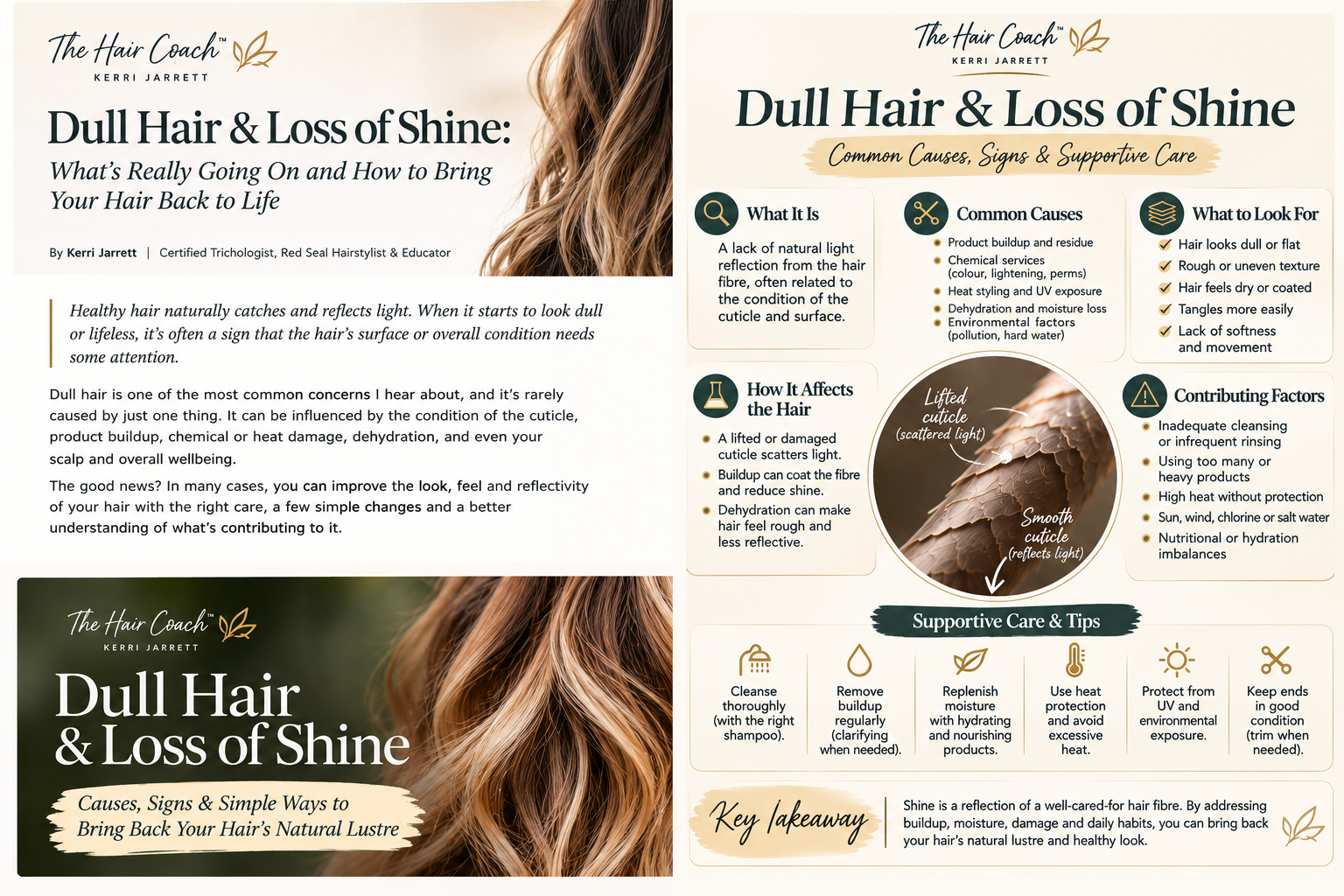
Shine is largely about how light interacts with the surface of your hair.
When the cuticle is relatively smooth and the strands are aligned, light tends to reflect more evenly. That's what creates the glossy appearance we often associate with healthy-looking hair.
When the surface is rough, irregular or coated with certain residues, light may scatter in different directions.
The result is hair that appears duller.
But there's an important detail here.
Shine is not a perfect measurement of hair health.
Naturally curly, coily and highly textured hair may reflect light differently from straight hair because of the way the strands bend and interact with light.
That doesn't mean it's unhealthy.
And very shiny hair isn't automatically structurally healthy either. Some cosmetic products are excellent at creating surface gloss, even when the underlying fibre has experienced damage.
Appearance gives us clues. It doesn't tell us everything.
Why Does Hair Lose Its Shine?
There are several possible explanations, and sometimes more than one is involved.
1. Product Buildup
This is one of the first things I consider when someone tells me their hair feels heavy, coated or dull.
Conditioners, styling creams, oils, waxes, dry shampoos and other products can leave deposits on the hair, depending on their formulation and how they're used.
Some of those ingredients are beneficial. They help with lubrication, manageability, protection and styling.
The problem isn't that products leave something behind.
It's when the accumulation no longer suits the hair's needs.
You may notice hair that feels waxy, stiff, sticky or difficult to style. It might lose movement, appear flat or become harder to detangle.
And here's where people sometimes get caught in a frustrating cycle.
Their hair looks dull, so they add more shine product.
Now the hair feels heavier, so they add something else to give it volume.
Before long, they're trying to solve one problem with six different bottles.
Sometimes your hair doesn't need more. It needs a proper cleanse.
2. Mineral Deposits and Water Quality
Water can also influence how your hair looks and feels.
Hard water contains higher concentrations of minerals, particularly calcium and magnesium.
Under certain conditions, mineral deposits can accumulate on the hair and interact with cleansing products.
Some people notice reduced manageability, a coated feeling or changes in how their hair responds to products.
But I wouldn't assume hard water is responsible for every case of dullness.
Water chemistry, hair condition and the products you're using all matter.
If buildup is suspected, choosing an appropriate clarifying or chelating product may be helpful. Those products don't necessarily do the same job, so it's worth understanding the difference.
3. Chemical Processing
Colouring, bleaching, perming and chemical straightening can alter the structure and surface of the hair fibre.
When the cuticle becomes more irregular or compromised, light may reflect less evenly.
Hair can also become more prone to tangling, roughness and breakage.
This is especially relevant for hair that has been repeatedly lightened or chemically processed.
A gloss or conditioning treatment may improve the appearance of shine, but it doesn't automatically restore the fibre to its original structural condition.
If you're interested in the chemistry behind this, I've covered it more thoroughly in my article on Chemical Hair Damage.
4. Heat Styling and Everyday Wear
Repeated exposure to excessive heat can affect the cuticle and internal structure of the hair.
Friction from brushing, towels, clothing and everyday handling can also contribute to surface wear over time.
As the fibre becomes rougher, it may lose some of its natural lustre.
The interesting part is that heat can temporarily make hair look shinier by smoothing and aligning the strands during styling.
But repeated high-temperature styling can also contribute to long-term damage.
A beautiful finish today doesn't necessarily tell us how the fibre will hold up over time.
You can learn more about that in my Heat Damage article.
5. Conditioning and the Hair's Surface
Hair that feels rough or lacks lubrication may appear dull and be more difficult to manage.
Appropriate conditioners and leave-in products can help improve surface feel, reduce friction and enhance the appearance of shine.
But I want to clear up something we hear constantly in hair care.
Dry-looking hair isn't always simply lacking water.
Hair's behaviour depends on its structure, moisture interactions, surface lipids, chemical history and environmental conditions.
Adding heavier and heavier moisturizing products isn't always the answer.
Sometimes the hair needs better conditioning.
Sometimes it needs buildup removed.
And sometimes it needs less heat and friction.
6. Environmental Exposure
Sunlight, wind, swimming pools, pollution and seasonal changes can all influence hair appearance and manageability.
Living somewhere with dry winters, indoor heating and frequent weather changes can make those effects especially noticeable.
Environmental exposure can add to existing fibre wear, particularly when the hair is already chemically processed or fragile.
Again, it's usually the combination of influences that tells the story.
How Do You Know What's Causing Your Dull Hair?
This is where I encourage you to observe before changing your routine.
Ask yourself a few questions.
Does your hair feel heavy or coated shortly after washing?
Are your roots greasy while your ends feel rough?
Does your hair look dull even when it's freshly cleansed?
Has the change happened since a colour service?
Are you using more dry shampoo, oils or styling creams than you used to?
Does your hair feel different after swimming or travelling somewhere with different water?
These little details matter.
For example, the product-buildup cases in my educational references describe hair that looks flat, has reduced movement and sometimes shows visible residue near the roots or along the strands.
That's a very different starting point from someone whose hair has become rough and brittle after repeated bleaching.
Both may complain about a lack of shine.
But I wouldn't approach them with the same solution.
Is It Buildup or Actual Hair Damage?
This is probably one of the most useful distinctions you can make.
If buildup is the main issue, appropriate cleansing may noticeably improve the hair's appearance and feel.
If the fibre itself is damaged, removing buildup won't reverse the underlying structural changes.
And sometimes both are happening together.
That's why I don't recommend reaching for a strong clarifying shampoo every time your hair looks dull.
Clarifying products can be useful, but the right frequency depends on your products, water conditions, scalp needs and hair condition.
Overcleansing or using an unsuitable cleanser may leave the hair feeling rougher.
The goal isn't to strip everything off your hair. It's to remove what doesn't belong while maintaining what the hair needs.
How Can You Bring Back Shine?
Let's keep this practical.
Start With Your Cleansing Routine
Choose a shampoo that suits your scalp and the products you regularly use.
If your hair feels coated or heavy, consider whether occasional clarification is appropriate.
And don't forget to rinse thoroughly.
Sometimes the simplest habits make the biggest difference.
Condition According to Your Hair's Needs
Fine hair may benefit from lighter conditioning formulas, while more weathered or chemically processed lengths may need richer products.
Neither approach is automatically better.
The right conditioner should help your hair feel manageable without leaving it unnecessarily weighed down.
Review How Much Product You're Using
More shine serum doesn't always mean more shine.
Pay attention to where you're applying products and how much you actually need.
For many people, concentrating richer products on the mid-lengths and ends makes more sense than applying them heavily at the roots.
Be Thoughtful With Heat
Heat styling can create a polished finish, but excessive temperatures and repeated passes can contribute to damage.
Use suitable heat protection and work with your hair's condition rather than forcing it to tolerate more than it should.
Look After Your Ends
Older lengths have been exposed to more washing, brushing, styling and environmental wear.
If your ends are split, rough or heavily compromised, conditioning alone may not be enough.
A maintenance trim or my SOS Cut may be worth considering when damaged ends are affecting manageability and length retention.
Give Your Routine Time, Then Reassess
If you've made a few sensible changes, pay attention to how your hair responds.
Does it feel lighter?
Is it easier to detangle?
Does it have more movement?
Is the shine improving, or are you simply coating the problem?
You don't need to change every product at once to learn something useful about your hair.
In fact, changing fewer things often makes it easier to understand what's helping.
What About Gloss Treatments and Shine Products?
I love a beautiful gloss.
And there's absolutely a place for cosmetic treatments that improve shine, smoothness and colour appearance.
Some products work by depositing conditioning ingredients or forming a film that changes how the hair surface interacts with light.
Others may involve colour or tonal changes that improve the appearance of the hair.
These can be wonderful options when used appropriately.
But I always want people to understand the difference between making hair look shinier and improving the condition of the fibre.
Sometimes those benefits overlap.
Sometimes they don't.
And neither should be confused with biologically healing damaged hair.
When Should You Look Beyond Your Hair Care Products?
If your hair has gradually become dull because of buildup or everyday wear, changes to your routine may be enough.
But if you're noticing a sudden change in hair quality alongside increased shedding, thinning, scalp irritation or other symptoms, it's worth taking a closer look.
Some medical conditions, nutritional concerns and changes in hair production can affect the characteristics of newly growing hair.
That doesn't mean dullness alone indicates a health problem.
It means we shouldn't automatically assume every change can be explained by shampoo.
Sometimes the concern is cosmetic.
Sometimes it's structural.
And occasionally, there's something more to investigate.
Better Shine Starts With Better Understanding
After years working with hair, one thing I know is that the answer isn't always another product.
Sometimes it's removing buildup.
Sometimes it's adjusting your conditioning routine.
Sometimes it's changing how you style your hair.
And sometimes it's recognizing that the fibre has experienced damage that needs a more realistic plan.
As a Red Seal Hairstylist and Certified Trichologist, I look at hair from both the cosmetic and structural sides.
I want you to enjoy your hair, understand how to care for it and feel confident making decisions about products and treatments.
If you're frustrated with dullness, buildup or a routine that doesn't seem to be working, personalized hair coaching can help you figure out what your hair actually needs.
If you're experiencing persistent or unexplained changes in hair quality, increased shedding, scalp symptoms or changes in density, a Comprehensive Trichology Assessment, available in person or virtually, may be a more appropriate starting point.
And if you're not sure which direction to take, you can always begin with a complimentary 15-minute discovery call.
Because sometimes the secret to shinier hair isn't adding something new. It's understanding what's already there.
Kerri Jarrett
Certified Trichologist | Red Seal Hairstylist | Educator
Explore Hair Fibre Education | Explore Hair Coaching | Book a Free Discovery Call


Let’s Talk Hair.
Hair loss. Scalp health. Hair growth. Hair fibre. Hair care. Get evidence-informed education, practical insights and new resources delivered to your inbox—designed to help you better understand what your hair and scalp may be telling you and make more informed decisions about what comes next. Because better questions lead to better answers.


