Dry Hair: Causes, Signs & What Your Hair Really Needs
Dry Hair
Why Your Hair Feels Dry and What It Actually Needs
Because sometimes the answer isn't another moisturizing mask.
By Kerri Jarrett | Certified Trichologist, Red Seal Hairstylist & Educator
Have you ever spent a small fortune on moisturizing shampoos, conditioners and hair masks, only to find your hair still feels dry?
Maybe your ends are rough. Your hair tangles the moment you look at it. Or you apply a beautiful leave-in conditioner, enjoy soft hair for a day, and then you're right back where you started.
I've seen this so many times throughout my career.
And one of the first things I want people to understand is that dry-feeling hair doesn't always mean your hair simply needs more water.
Sometimes we're dealing with damaged cuticles. Sometimes it's a lack of lubrication. Sometimes the products aren't suitable for your hair. And sometimes what feels like dryness is actually a combination of several things.
Before we add another product to the routine, I think it's worth asking a better question.
Why does your hair feel dry in the first place?
What Does Dry Hair Actually Mean?
When we describe hair as dry, we're usually talking about how it feels and behaves.
It may feel rough, stiff, brittle or difficult to comb. It might look dull, become tangled easily or seem to lack flexibility.
But unlike your skin, the visible hair shaft isn't living tissue that can regulate its own hydration.
Hair contains water, and the amount changes depending on environmental humidity and the fibre's condition. Hair also contains lipids that contribute to its surface properties and behaviour.
When the cuticle is compromised, the hair may become rougher, experience more friction and interact differently with water.
This is why two people can describe their hair as dry but need completely different approaches.
One might benefit from better conditioning. Another may need to reduce heat and chemical processing. Someone else may simply be using a cleanser that doesn't suit their hair.
The feeling is real. The explanation isn't always obvious.
What's Happening to the Hair Fibre?
Let's look at two important parts of your hair.
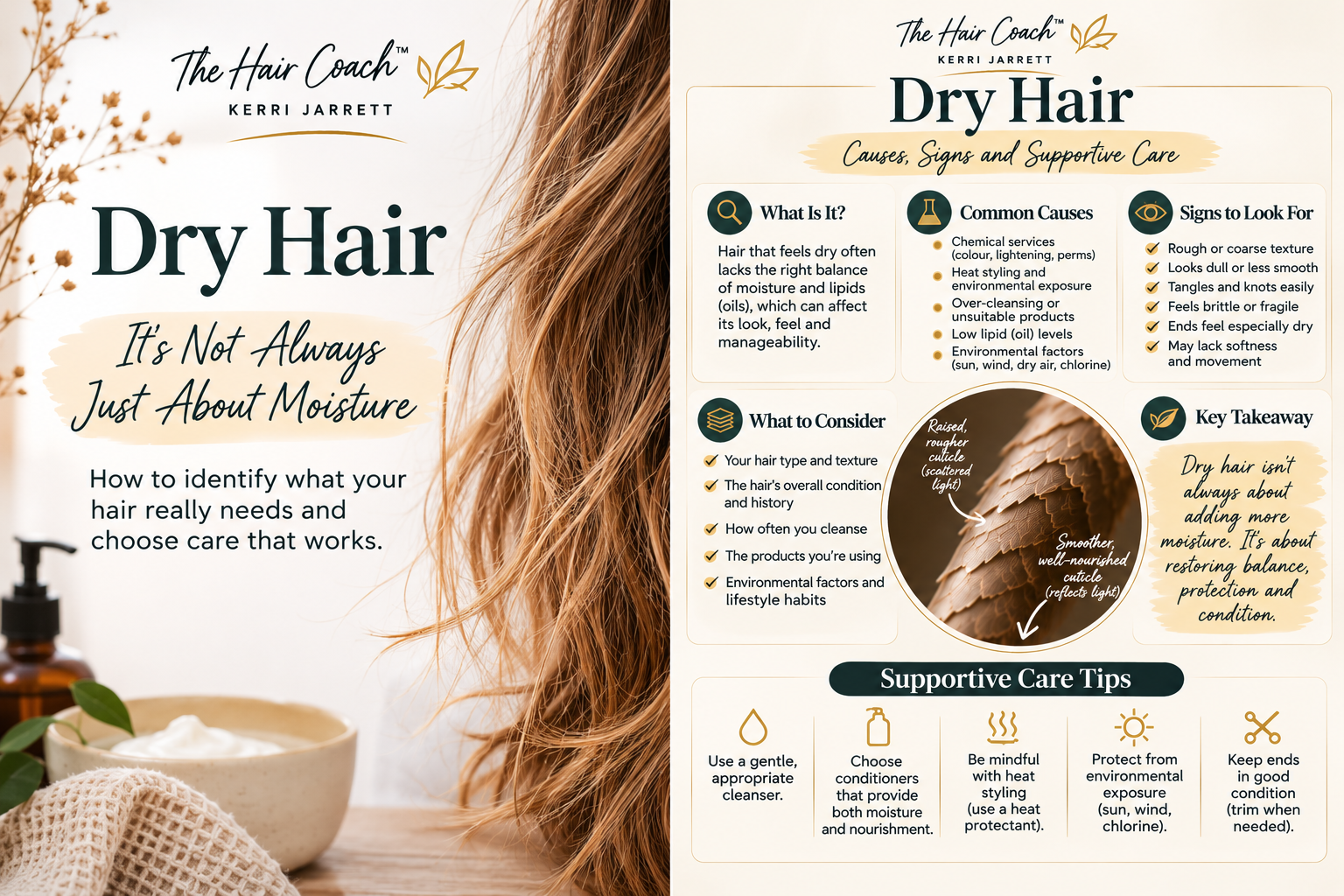
The cuticle is the protective outer layer made up of overlapping cells. Its condition influences friction, tangling, shine and how the fibre interacts with its environment.
The cortex makes up much of the internal structure and contributes to the hair's strength, elasticity and other physical properties.
When the cuticle becomes worn through chemical processing, heat or mechanical friction, the fibre may become more difficult to manage.
Damage can also affect internal components, including proteins and lipids.
The result may be hair that feels dry, rough or unusually fragile.
But there's an important distinction.
Hair that feels dry isn't automatically damaged, and damaged hair doesn't always feel dry.
That's why appearance and texture alone don't tell the whole story.
Why Does Hair Become Dry?
Usually, there isn't one single cause. It's often a combination of influences that build up over time.
1. Your Cleansing Routine
Shampoo has an important job. It removes excess sebum, sweat, dirt and product residue from the scalp and hair.
But not every cleanser is appropriate for every person.
A strong cleansing formula used too frequently for your needs may leave your lengths feeling rough or difficult to manage.
On the other hand, inadequate cleansing can allow residue to accumulate, making hair feel coated, stiff or heavy.
The goal isn't to avoid shampoo.
It's to find a cleansing routine that works for your scalp, your hair and the products you're using.
2. Chemical Processing
Colouring, bleaching, perming and chemical straightening can change the hair's structure.
Repeated or aggressive processing may affect the cuticle, proteins and lipids, increasing the fibre's vulnerability to roughness, tangling and breakage.
This is particularly important for hair that has been lightened several times.
You might be applying conditioner faithfully, but if the fibre is significantly compromised, conditioning alone cannot return it to its original structure.
I've explored this more thoroughly in my article on Chemical Hair Damage.
3. Heat Styling
I love a good blowout as much as anyone.
But repeated exposure to excessive heat can contribute to changes in the hair's surface and internal structure.
Flat irons, curling wands and blow-dryers all need to be used with consideration for the hair's condition.
Heat protection can help reduce certain forms of damage, but it doesn't make the fibre indestructible.
And if your hair already feels brittle or breaks easily, turning up the temperature probably isn't doing it any favours.
You can read more in my Heat Damage article.
4. Environmental Exposure
Sunlight, wind, swimming pools, saltwater and dry environmental conditions can influence how your hair looks and behaves.
Here in Alberta, we're certainly familiar with dry winter air and indoor heating.
Lower humidity can change the hair's water content and contribute to static or different styling behaviour.
But humidity alone doesn't determine whether the hair is healthy or damaged.
It's another piece of the puzzle.
5. Friction and Everyday Handling
Hair experiences wear every day.
Brushing, detangling, tight elastics, towels, clothing and even sleeping can contribute to friction.
Over time, repeated mechanical stress may wear down the cuticle, especially through older lengths and ends.
And if the hair is already chemically processed, it may be less tolerant of additional handling.
Sometimes the most useful change isn't a new treatment.
It's learning to be a little gentler with the hair you already have.
6. Your Natural Hair Characteristics
Some hair types naturally feel different from others.
Curly and coily hair, for example, can have different surface characteristics, sebum distribution and styling needs compared with straighter hair.
Fine hair may become weighed down by rich products, while other hair may benefit from more substantial conditioning.
Neither is automatically healthier.
There is no universal dry-hair routine because there is no universal head of hair.
Is Your Hair Dry, Dehydrated or Highly Porous?
These words are often used interchangeably, but they don't mean exactly the same thing.
Dry hair is usually a description of how the hair feels or appears.
Hair hydration refers to the water associated with the fibre, which changes with environmental conditions.
Porosity describes how readily the hair takes up and releases water and other substances, influenced by its structure and condition.
Heavily processed or damaged hair may have altered porosity, but porosity alone doesn't tell us everything about its strength.
And contrary to what you may have seen online, dropping a strand into a glass of water isn't a reliable way to determine your hair's porosity.
There are too many variables involved.
I prefer to consider the hair's history, surface condition, manageability, response to products and any signs of structural damage.
Because a floating hair doesn't tell me nearly as much as a proper conversation about what you've been doing to it.
What About Your Hair's Natural Oils?
Sebum is produced by sebaceous glands associated with hair follicles.
It helps lubricate the scalp and can contribute to the surface condition of the hair.
But the amount and distribution of sebum vary.
Longer hair and certain curl patterns may experience less sebum distribution through the lengths, which can influence how the ends feel.
This is one reason conditioning is useful even when your scalp produces plenty of oil.
You can have an oily scalp and dry-feeling ends at the same time.
And no, that doesn't necessarily mean you need to stop washing your scalp.
Your scalp and your hair lengths have different needs.
Does pH Matter for Dry Hair?
Yes, but not quite in the way it's sometimes explained online.
The pH of a hair product can influence how the formulation interacts with the hair and scalp.
Highly alkaline chemical processes can contribute to changes in the hair fibre, including swelling and increased vulnerability to damage under certain conditions.
But the idea that every slightly acidic product automatically seals the cuticle is an oversimplification.
Product performance depends on the complete formulation, not just the pH printed on a label.
I wouldn't recommend trying to fix dry hair with homemade acidic rinses or choosing products based on pH alone.
A well-formulated shampoo or conditioner that's appropriate for your hair is a much better starting point.
How Do You Know What Your Dry Hair Actually Needs?
This is where I like to encourage a little observation.
Before changing your entire routine, ask yourself:
Does my hair feel dry immediately after shampooing or only a day or two later?
Is the dryness concentrated through the ends, or does it affect the entire length?
Has my hair been coloured, lightened or chemically straightened?
Am I using high heat regularly?
Does my hair feel rough, or does it feel coated and heavy?
Is it tangling more than usual?
Am I noticing actual breakage or just a change in texture?
These questions help us narrow down what might be contributing.
For example, someone with repeatedly bleached hair, rough ends and frequent breakage may need a very different plan from someone whose hair feels heavy and stiff because of product buildup.
Both might describe their hair as dry.
But I wouldn't automatically give them the same products.
How to Care for Dry-Feeling Hair
You don't need a twelve-step routine.
You need a routine that makes sense for the hair you're working with.
Choose an Appropriate Cleanser
Start with your scalp's cleansing needs and consider how your hair responds after washing.
If your lengths feel excessively rough, your shampoo, washing technique or cleansing frequency may need adjusting.
If your hair feels coated, buildup may be contributing.
The goal is effective cleansing without unnecessary roughness.
Condition Consistently
Conditioner helps improve lubrication, reduce friction and make the hair easier to detangle.
For many people with dry-feeling lengths, consistent conditioning is more useful than occasionally applying an expensive mask and hoping for the best.
Choose the texture and richness according to your hair's characteristics.
Consider a Leave-In Product
A suitable leave-in conditioner can provide additional lubrication, improve manageability and help reduce friction during styling.
Some formulations also offer heat protection.
But check what the product is actually designed to do.
A leave-in conditioner and a high-temperature heat protectant aren't always interchangeable.
Use Masks and Treatments With a Purpose
A hair mask can be helpful, particularly for hair that needs additional conditioning.
Certain strengthening or bond-building products may also improve properties of damaged hair.
But more treatment isn't always better.
And no mask can permanently reconnect a physically split hair end or biologically regenerate a severely damaged fibre.
Choose treatments based on the concern you're trying to address.
Be Gentle With Detangling
Use an appropriate brush or comb, work gradually through tangles and avoid pulling against resistance.
Conditioning products can help provide slip.
The goal is to reduce unnecessary tension and friction, especially when the hair is already compromised.
Rethink Your Heat Habits
Use suitable heat protection and the lowest practical temperature for your styling goals.
Avoid repeatedly passing hot tools over the same section.
And never use a conventional flat iron on wet hair.
Protect Your Ends
Your ends are the oldest part of your hair.
They've been through every wash, brush, colour appointment and styling session since they grew from your scalp.
If they're severely split or breaking, conditioning may improve how they feel, but trimming is the reliable way to remove those damaged portions.
This is where my SOS Cut can be a useful option for someone trying to preserve length while addressing compromised ends.
Can Dry Hair Become Healthy Again?
That depends on why it feels dry.
If the concern is primarily related to cleansing, conditioning, product choice or environmental conditions, adjusting your routine may make a noticeable difference.
If the fibre has significant structural damage from chemical processing, heat or repeated mechanical wear, we can often improve its appearance, manageability and certain physical properties.
But we cannot return severely damaged hair to its original, untouched state.
That's why I focus on three things:
Improve what can be improved. Protect what remains. Support healthier new growth.
Sometimes that means changing products.
Sometimes it means changing habits.
And sometimes it means accepting that a little damaged length needs to go.
Not exactly the miracle-in-a-bottle answer, I know.
But it's a far more useful one.
When Is Dry Hair More Than a Cosmetic Concern?
Most dry-feeling hair concerns can be approached through appropriate fibre care.
But if you're experiencing sudden changes in hair quality alongside significant shedding, visible thinning, scalp irritation, flaking or other symptoms, it's worth looking more closely.
Certain medical conditions, nutritional deficiencies and changes in hair production can influence the characteristics of newly growing hair.
That doesn't mean dry hair alone indicates an underlying health problem.
It means we shouldn't assume every concern can be solved through a different shampoo.
And if your scalp itself is persistently dry, itchy, inflamed or flaky, that's a separate conversation from dry hair lengths.
Better Hair Care Starts With Understanding
One of the things I enjoy most about working with hair is helping people recognize patterns they may have overlooked.
Sometimes the solution is surprisingly simple.
Other times, there's a history of chemical processing, heat, friction or product choices that we need to untangle.
As a Certified Trichologist and Red Seal Hairstylist, I look at both the cosmetic condition of the hair and the bigger picture when appropriate.
If you're struggling with dry-feeling hair, confused about products or unsure how to build a routine that works, personalized hair coaching can help you make sense of your options.
If you're experiencing persistent or unexplained changes in hair quality, significant breakage, shedding or scalp concerns, a Comprehensive Trichology Assessment, available in person or virtually, may be a more appropriate starting point.
And if you're unsure where to begin, you're welcome to book a complimentary 15-minute discovery call.
You don't need more products just for the sake of having more products.
You need to understand what your hair is asking for.
Kerri Jarrett
Certified Trichologist | Red Seal Hairstylist | Educator
Explore Hair Fibre Education | Explore Hair Coaching | Book a Complimentary Discovery Call


Let’s Talk Hair.
Hair loss. Scalp health. Hair growth. Hair fibre. Hair care. Get evidence-informed education, practical insights and new resources delivered to your inbox—designed to help you better understand what your hair and scalp may be telling you and make more informed decisions about what comes next. Because better questions lead to better answers.


