Chemical Hair Damage: Causes, Signs & Care Tips
Chemical Hair Damage
What Colouring, Bleaching & Straightening Really Do to Your Hair
Understanding chemical damage, recognizing the warning signs and making better decisions before your next hair appointment.
By Kerri Jarrett | Certified Trichologist, Red Seal Hairstylist & Educator
Let me start with a confession.
I love hair colour.
I've spent years creating it, correcting it and helping people find a look that makes them feel like themselves. There's something wonderful about a beautiful blonde, a rich brunette or a complete colour transformation.
But there's another side to chemical services that I wish more people understood.
Just because your hair looks beautiful when you leave the salon doesn't necessarily mean it's in the same condition as when you arrived.
And that doesn't mean your hairstylist did something wrong.
Chemical services work by changing something about the hair. The important part is understanding what those changes involve, what your hair can tolerate and how to care for it afterward.
Because beautiful hair and informed hair care should go hand in hand.
What Is Chemical Hair Damage?
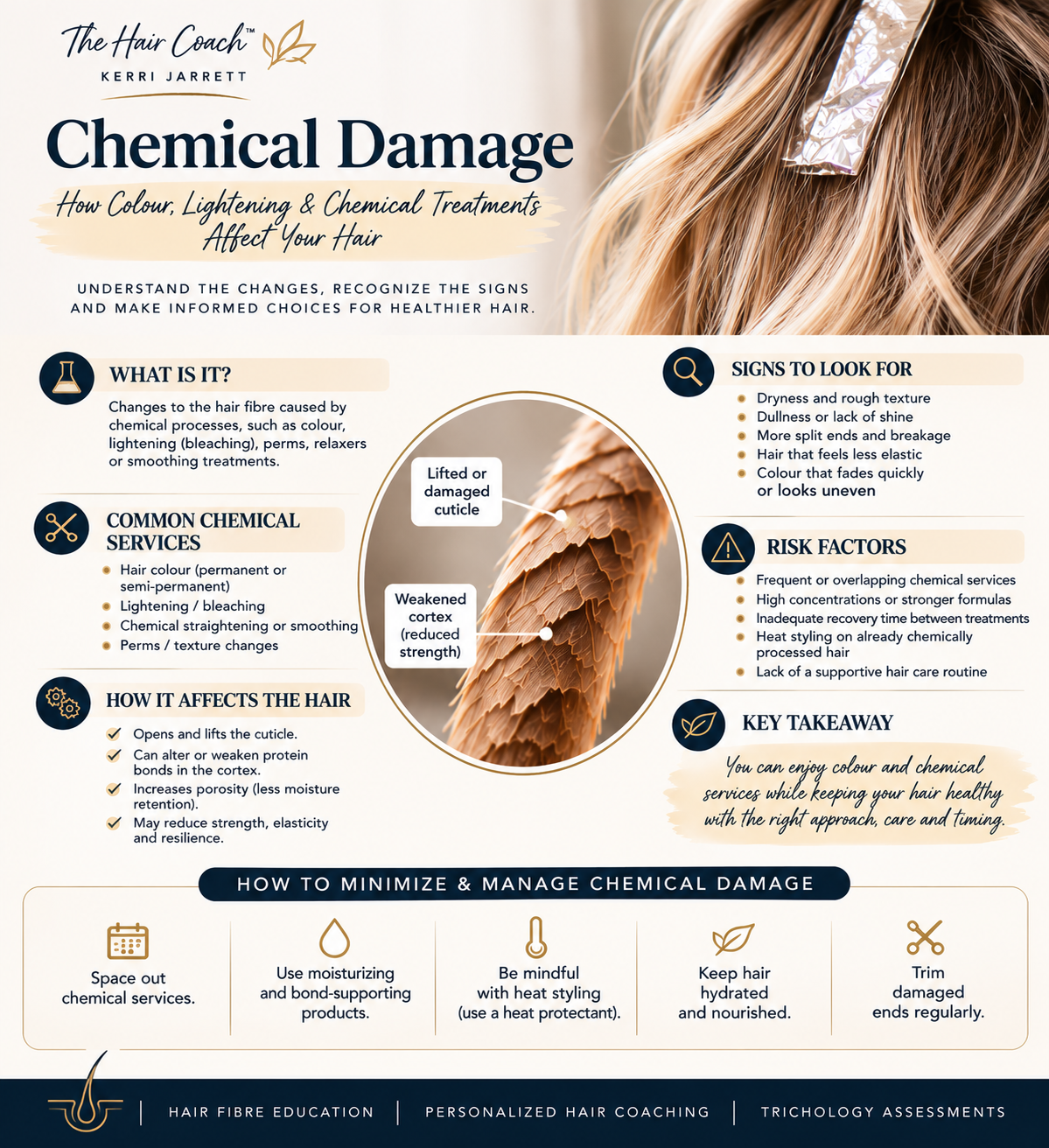
Chemical damage occurs when a treatment changes or compromises the hair's structure beyond what the fibre can comfortably tolerate.
Colouring, bleaching, perming, relaxing and chemical straightening all involve chemical processes, but they don't all work the same way.
Some change the hair's pigment. Others alter the chemical bonds that influence its shape.
Many of these services involve changes to the cuticle and cortex.
The cuticle is the outer protective layer of your hair, while the cortex contains much of the fibre's keratin structure and contributes to its strength, elasticity and colour.
When chemical processing is excessive, repeated too frequently or performed on already compromised hair, the fibre may become more vulnerable to dryness, tangling, splitting and breakage.
Here's the distinction I want you to remember:
A chemical service changes the hair. Chemical damage is about the nature and extent of those changes.
Not every colour appointment leaves hair severely damaged. But no chemical service should be approached without considering the hair's existing condition.
What Actually Happens When You Colour or Lighten Your Hair?
Let's talk about the chemistry without turning this into a science lecture.
Permanent Hair Colour
Many permanent oxidative hair colours use an alkaline environment and an oxidizing agent to help colour molecules develop within the hair.
The process changes the hair's pigment and can also affect the fibre's structure, particularly with repeated processing.
This is one reason I pay attention to whether we're colouring new growth or repeatedly applying permanent colour over previously treated lengths.
Those ends have a history.
And sometimes they've already been through more than enough.
Bleaching and Lightening
Lightening generally involves stronger oxidative changes because we're breaking down natural or artificial pigment to achieve a lighter result.
Along the way, the process can also affect proteins, lipids and other components of the hair fibre.
The more aggressively or repeatedly hair is lightened, the greater the potential for significant structural damage.
This is why going from dark hair to very light blonde isn't simply a matter of leaving bleach on longer.
There's a limit to what the fibre can tolerate.
And sometimes the healthiest decision is to work toward a colour goal gradually.
Perming, Relaxing and Chemical Straightening
These treatments alter the chemical interactions that influence hair shape.
Depending on the service, they may involve breaking and reforming disulfide bonds or other chemical changes to the fibre.
They're not interchangeable processes, and their risks depend on the chemistry used, the condition of the hair and the application technique.
Combining incompatible services or repeatedly processing compromised hair can result in serious breakage.
The fact that a service is technically possible doesn't always mean it's appropriate for the hair sitting in front of us.
That's where professional judgment matters.
How Can You Tell If Your Hair Is Chemically Damaged?
Sometimes the signs are obvious.
Other times, they're easy to mistake for hair that simply needs more conditioner.
You might notice:
Hair that feels rough, dry or unusually brittle.
Dullness or a noticeable loss of shine.
Increased tangling, especially through the lengths and ends.
Hair that stretches excessively when wet or snaps with little tension.
More split ends or shorter broken strands.
Changes in your natural curl pattern or texture.
Hair that no longer responds to styling the way it once did.
One of your reference cases describes repeatedly bleached hair that had become dull, rough, highly porous and prone to breakage.
That's a useful example because it shows how several signs can appear together.
But I wouldn't diagnose chemical damage from dullness or porosity alone.
We need to consider the hair's history, examine its condition and understand what has changed.
Let's Talk About Porosity and Elasticity
These two terms come up a lot when discussing chemically processed hair.
Porosity describes how readily hair takes up and releases water, influenced partly by its structure and surface condition.
Elasticity describes the hair's ability to stretch and return toward its original length.
Chemical processing can alter both.
For example, heavily lightened hair may absorb water differently, become harder to detangle or lose some of its ability to tolerate stretching.
But here's something important.
You can't reliably determine porosity by dropping a strand of hair into a glass of water and seeing whether it floats.
That popular test is influenced by too many variables to give a dependable assessment.
And pulling hard on a wet strand isn't a particularly good idea when the hair is already fragile.
I prefer looking at the hair's chemical history, behaviour and overall condition, using appropriate professional assessment methods when needed.
Because one quick test rarely tells the whole story.
Why Does Chemical Damage Get Worse Over Time?
Hair doesn't reset itself between appointments.
The lengths you coloured six months ago are still the same lengths you're colouring today, unless they've been cut away.
That's why chemical history matters so much.
Repeated lightening, overlapping applications, unsuitable processing conditions and additional heat styling can all increase the stress placed on the fibre.
And sometimes the problem isn't just the chemical service itself.
It's what happens afterward.
Frequent high-temperature styling, aggressive brushing, inadequate conditioning and friction can make already compromised hair more vulnerable to breakage.
Damage can be cumulative. What your hair tolerated last year may not be what it can tolerate today.
This is also why I don't believe in making chemical service decisions based on a photograph alone.
A picture tells me what you want your hair to look like.
It doesn't tell me what your hair can safely handle.
Can Chemically Damaged Hair Be Repaired?
This is where marketing can make things confusing.
You'll see products promising to rebuild, repair, reconstruct, restore and reverse damage.
Some of these technologies are genuinely useful.
Conditioning ingredients can improve lubrication and manageability. Certain strengthening and bond-building treatments may improve measurable properties of damaged hair.
Depending on the product and the type of damage, those improvements can be significant.
But here's what they cannot promise.
A severely damaged hair fibre cannot biologically regenerate back to its original, untouched state.
Once the hair has experienced permanent structural changes, we cannot simply turn back the clock.
What we can do is improve its condition and performance, reduce additional stress and create a realistic plan for the hair moving forward.
Sometimes that involves targeted treatments.
Sometimes it involves changing how the hair is coloured.
Sometimes it means taking a break from chemical processing.
And yes, sometimes it means cutting off the parts that are no longer holding up.
That's not failure.
That's understanding the limitations of the material we're working with.
What About Bond-Building Treatments?
I'm glad these technologies exist.
But I also think we need to understand what they're actually designed to do.
Different bond-building and strengthening products work through different mechanisms. Some target particular chemical interactions within the fibre, while others improve surface properties or help reduce breakage.
Their effectiveness depends on the formulation, the condition of the hair and how they're used.
A bond-building treatment may be a valuable part of a corrective plan.
But it isn't permission to keep bleaching hair that's already severely compromised.
A treatment can support the hair. It doesn't remove the need for good chemical judgment.
And that's a distinction I think both professionals and consumers should understand.
What Are Your Options If Your Hair Is Already Chemically Damaged?
First, we need to establish how much damage has occurred and where it's concentrated.
A little dryness after colouring is a very different situation from hair that is snapping throughout the lengths.
Review Your Chemical History
What services have been performed?
How frequently?
Were the same sections processed more than once?
Have different straightening, colouring or lightening systems been combined?
These details matter more than most people realize.
Reconsider Your Next Colour Appointment
Sometimes we can modify the service.
That might mean avoiding previously lightened areas, choosing a lower-impact colour strategy or adjusting the desired result.
Other times, the safest choice is to postpone further processing.
I know that's not always what someone wants to hear.
But I'd rather have an honest conversation about what your hair can tolerate than promise a result that leaves you with significantly less hair.
Choose Targeted Conditioning and Strengthening Care
Products should be selected according to the hair's condition, not simply because the label says repair.
A good routine may include appropriate cleansing, conditioning, leave-in protection and targeted treatments.
The goal is to improve manageability and reduce unnecessary damage.
More isn't always better.
Reduce Heat and Mechanical Stress
Chemically compromised hair may be less tolerant of flat irons, curling tools and aggressive detangling.
Reducing heat exposure and handling the hair more gently can make a meaningful difference.
Remove Severely Damaged Ends
If your ends are splitting, tangling and breaking, cutting away compromised sections may be necessary.
This is where my SOS Cut can be worth considering.
It's a length-conscious approach to removing damaged ends while preserving as much healthy hair as reasonably possible.
And sometimes a gradual cutting plan is more realistic than trying to remove all the damage in one appointment.
How Can You Prevent Chemical Damage?
You don't necessarily have to stop colouring your hair.
But I would encourage you to become more intentional about how you do it.
Start by understanding your hair's condition before your next service.
Be honest about previous colour, lightening, straightening and at-home chemical treatments.
Avoid repeatedly processing the same lengths without a clear reason.
Give your hair appropriate conditioning and protection between appointments.
And don't underestimate the importance of your hairstylist understanding both the chemistry and the condition of the fibre.
A good colour plan isn't just about achieving the shade you want today.
It's also about considering what condition your hair will be in six months from now.
When Is It More Than a Chemical Damage Concern?
Sometimes the issue is straightforward fibre damage.
But if you're experiencing sudden or unusual shedding, visible scalp changes, significant thinning or irritation following a chemical service, we may need to look beyond the hair shaft.
Chemical products can sometimes cause scalp irritation or allergic reactions. More serious reactions require medical attention.
And hair breakage can occasionally be confused with hair loss.
If you're noticing changes in overall density or scalp health, an assessment can help clarify what we're dealing with and whether further medical evaluation is needed.
Beautiful Hair Shouldn't Come at the Expense of Understanding It
I don't believe people should have to choose between enjoying their hair and caring for it.
I love creative colour. I love transformations. And I love helping people feel good about how they look.
But I also believe in knowing when to say, "Not today," or "Let's approach this differently."
That's not being difficult.
That's respecting the hair.
As a Red Seal Hairstylist and Certified Trichologist, I bring together cosmetology, hair fibre science and evidence-informed education to help people make informed decisions about their hair.
If you're struggling with chemically damaged hair, unsure which products to use or trying to maintain your colour without sacrificing your length, personalized hair coaching can help you develop a practical routine.
If you're experiencing significant breakage, unexplained changes in hair quality, unusual shedding or scalp concerns, a Comprehensive Trichology Assessment, available in person or virtually, may be a better place to start.
And if you're not sure which option makes sense, you're welcome to book a complimentary 15-minute discovery call.
You can love changing your hair. Just make sure you understand what you're asking it to go through.
Kerri Jarrett
Certified Trichologist | Red Seal Hairstylist | Educator
Explore Hair Fibre Education | Learn About the SOS Cut | Book a Free Discovery Call


Let’s Talk Hair.
Hair loss. Scalp health. Hair growth. Hair fibre. Hair care. Get evidence-informed education, practical insights and new resources delivered to your inbox—designed to help you better understand what your hair and scalp may be telling you and make more informed decisions about what comes next. Because better questions lead to better answers.


